Summary
Matthew Walker explores the science of sleep, including its importance for our health and the consequences of sleep deprivation. This includes how process C and process S contribute to our sleep rhythm and how we can modulate light, temperature, caffeine, alcohol, and sleep schedule based on chronotype to optimize sleep. Deep sleep and REM sleep (more evolutionarily recent) dictate sleep quality which is important along with sleep quality. Sleep is the most important factor to our holistic wellbeing and deserves optimization.
Key Takeaways
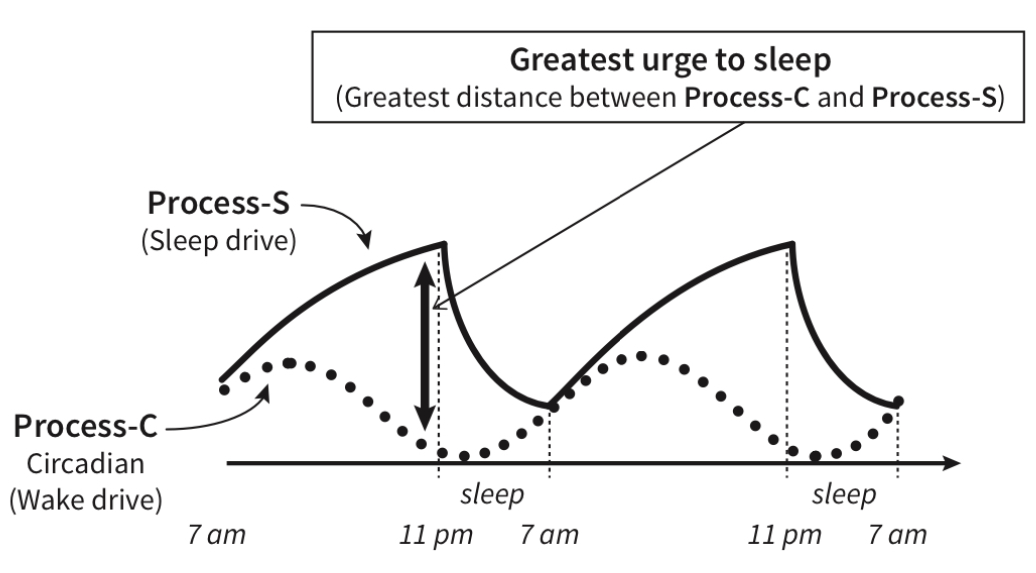
- Sleep rhythm’s two factors:
- Process C: circadian rhythm (melatonin)
- Process S: sleep pressure (adenosine, blocked by caffeine)
- Chronotype: 40% morning, 30% evening, 30% between (genetic)
- High degree of REM sleep contributes to social complexity, cognitive intelligence
- REM sleep dulls emotion in memories, encourages creativity
- Sleep detractors: light, temperature, caffeine, alcohol, inconsistent schedule
 overcast.fmMaster Your Sleep & Be More Alert When Awake — Huberman Lab
- Adenosine + caffeine: sleep pressure
- Cortisol + melatonin cycle
- Melatonin: mostly safe to take, but risk of interaction with other hormone systems
- Sunlight (morning 10-60m, sunset) sets circadian rhythm
- Natural dip in alertness around 2-4pm
- Naps under 90m beneficial (ideal 20-30m)
- Drugs:
- Magnesium threenate: 300-400mg
- Theanine: 100-200mg
overcast.fm#164 – Andrew Huberman: Sleep, Dreams, Creativity & the Limits of the Human Mind — Lex Fridman Podcast
- Temperature cycle
- Being fasted increases alertness
- Breathing in/out to affect alertness, HR
- Testosterone: makes effort feel good
overcast.fmThe Science & Practice of Perfecting Your Sleep | Dr. Matt Walker — Huberman Lab
- THC reduces REM sleep
- CBD beneficial as a thermoregulator, antidepressant, adenosine regulator
overcast.fmAMA #2: Improve Sleep, Reduce Sugar Cravings, Optimal Protein Intake, Stretching Frequency & More — Huberman Lab
- Deep sleep: metabolic regulator, HGH
- Avoid caffeine, alcohol, THC/CBD 8-12 hours before sleep
- Avoid eating 2 hours before sleep
- 60 minutes of exercise 6+ hours before sleep is beneficial for sleep
- Melatonin has effects on other hormones
Toolkit for Sleep - Huberman Lab
- Sleep stack:
- Magnesium Threonate: 145mg
- Theanine: 100-400mg
- Apigenin: 50mg
- Inositol: (keto sleep aid)
overcast.fmSleep Toolkit: Tools for Optimizing Sleep & Sleep-Wake Timing — Huberman Lab
- Morning and evening oscillators for circadian rhythm: want sun at both times
- Temperature minimum: 2 hours before normal wake up
- Wake up earlier to stay up later
Notes
1: Mechanics of sleep
1: Introduction
- Innate human drives: eat, sleep, drink, reproduce
- Bad sleep leads to:
- Alzheimer’s, cancer, immune system
- Worse weight loss, more hunger
2: Controlling sleep rhythm
- Two factors: circadian rhythm and sleep pressure
- Circadian rhythm: natural rhythmic daily cycle in body
- Naturally 24.25 hours but varies significantly
- Peak performance in afternoon
- Zeitgeber: cue for circadian rhythm
- Mainly sun but can also use food, exercise, social interaction as resets
- Suprachiasmatic nucleus: brain’s internal clock that controls circadian rhythm
- Chronotype: personal sleep tendencies
- 40% morning larks: best at dawn
- 30% evening owls: best late, sleep late
- 30% somewhere between two types
- Genetically evolved variation
- Melatonin: hormone regulating drowsiness that builds during day, peaking during sleep
- Adenosine: hormone that builds up sleep pressure
- Caffeine: blocks receptors adenosine would normally bind to, making agent
- Average caffeine half-life is 5.5 hours but varies widely
- Process-C and Process-S work independently
- Together determine wakefulness / desire to sleep
3: Defining and generating sleep
- Brain is remarkably accurate at keeping time while asleep, just don’t have conscious access
- Time dilation: during dreams
- REM sleep: slow neural replay of day, dreaming, similar activity to awake state
- Strengthens learned material / connections
- NREM sleep: stages 1-4 of depth
- Deep + core sleep prune unneeded memories
- 90 min cycles of REM, NREM (core) sleep
- Cycle length correlated with brainstem width
4: Who sleeps, how, and how much?
- Sleep is ubiquitous, inherent in life
- Sleep time need loosely correlated with size + complexity of nervous system, brain relative to body size
- REM sleep more evolutionarily recent
- Sleep more poor in new environment, semi-hemispherical until adapted to new place
- Species have variety of sleep, tools, adaptations, and techniques
- Post-prandial alertness dip: dip in alertness in afternoon (nap)
- Bi-phasic sleep: seems to be more natural for humans
- Tree to ground sleep → more REM sleep
- High degree of REM sleep contributes to social complexity, cognitive intelligence
5: Sleep across lifespan
- Sleep needs highest directly after birth
- Less REM sleep as aging, settling on 20/80
- Ability to learn, retain, persist new memories remains despite connectivity downscaling during development
- Circadian rhythm favors earlier sleep for children, later than adults for adolescents
- Sleep needs, quality decrease with age
2: Why should you sleep?
6: Benefits of sleep
- Sleep benefits every biological system, body and brain
- 20% learning advantage after nap
- Sleep spindles: replenishes ability to learn via transfer from hippocampus to pre-frontal cortex
- Externally stimulating brain during sleep can double rate of memory retention
- Targeted memory reactivation: stimulus during sleep can trigger specific storage
- Sleep helps automate, smooth out movement routines in subconscious brain
7: Sleep deprivation and the brain
- Performance degradation after 15-16 hrs
- 4 hours of sleep = performance when drunk
- Brain isn’t great at diagnosing sleep deprivation, becomes new baseline
- Sleep deprivation polarizes emotions
- Study: 60% increase in uncontrolled emotions when sleep deprived
- Buildup, linked to Alzheimer’s disease
8: Sleep deprivation and the body
- Sympathetic overdrive: Increased HR, blood pressure, cortisol / stress
- Decreased insulin function: diabetes, obesity, leptin + ghrelin malfunction
- 40% increase in cravings for simple carbs
- Worse weight loss: 4.5 hrs sleep → 30% fat mass lost, 8.5 hrs → >50% fat mass
- Lower testosterone, 30% lower sperm count
- Reduced immune system function → cancer
- Reduced gene function
3: Dreaming
9: REM-sleep dreaming
- Emotional, visual, autobiographical, motor regions particularly active during REM sleep
- Can determine high-level subjects from brain scans during dreaming
- Freudian theory of dreams unprovable
- Dreams not simple replays of day’s events
- Only carryover from day are emotions
10: Dreaming as overnight therapy
- REM sleep dulls emotion in memories
- PTSD when emotions not properly processed during sleep, noradrenaline high
- Low sleep decreases empathic ability
11: Dream creativity and control
- Creativity and puzzle solving 15-35% better immediately after waking from REM sleep
- Highly fluid, creative, open-minded
- Study: 3x creative insight after 8 hrs sleep
- Dreaming contextualizes day within existing knowledge, forming disparate connections
- 20% of humans are natural lucid dreamers
4: Sleeping tips
12: Sleep disorders
- Sleepwalking: state of semi consciousness
- Occurs during deep, not REM sleep
- Insomnia: trouble falling or maintaining sleep at least 3x/week for 3+ months
- 1/9 adults in US, 2x common in women
- Narcolepsy, sleep paralysis
- FFI: inability to sleep leads to slow death
- Autoimmune dysfunction ultimately kills
13: Sleep detractors
- Electric light: affects internal clock by 2 hrs
- Blue light: 2x melatonin suppression
- Temperature: need daily fluctuation as cue
- 15-25% faster sleep when colder
- Hot bath before bed: 15% ↑ REM sleep
- Caffeine: prevents sleep pressure buildup
- Alcohol: affects REM memory formation
- 50% deficit, even 3+ days after
- Forced waking: need consistent schedule
- A legacy of punching time cards
- Hitting snooze is bad, heart shock
14: Pills vs therapy
- Pills generally just sedatives
- Leads to low quality sleep, grogginess
- Increased cancer risk etc.
- CBTI: endorsed solution
- Exercise 3+ hours before bed
- Avoid high carbohydrate diets
15: Sleep and society
- 2% GDP loss attributable to lost sleep
- NASA: 30 min sleep → 50% more alert
- School should start later
- Medical residency hours should be eased
16: A new vision
- Wearables to detect circadian rhythm
- Smart thermostats that regulate temperature, non-constant overnight to match CR
- Smart lights (blue in morning)
- Calendar → slowly shift schedule
- Quantified self for self-improvement
- Work should incentivize good sleep, be more flexible for different chronotypes
- Car monitors for drowsiness
- Insurance incentives for proper sleep
Conclusion
- Need to reduce stigma of good sleep
- Obey our evolved biological clocks, needs
52- Why We Sleep