Thinking in Bets
Annie Duke2018
- Length
- 6h 50m~276 pages
- Read
- Sep 12th - Oct 20th '21
Summary
Life is poker, not chess: probabilistic, full of luck, and with rational decision-makers who occasionally deceive. Humans aren’t comfortable with uncertainty, hence hindsight bias and self-serving bias. Every decision should be a bet where we accept uncertainly, weigh outcomes, and redefine “right” as belief/systems-based rather than results-based.
Form a decision pod with diverse viewpoints to bounce ideas off of and engage in truth seeking to locate sources of error. Update your beliefs and values as results from your systems of operation come in. Before making big decisions, leverage backcasting, pre-mortems, and mental time travel (10/10/10).
Key Takeaways
- Create a decision pod / urban tribe: a trusted group to bounce potential decisions off of. Holds you accountable
- Ask if someone wants to vent or is truth seeking (wants advice)
- Mental time travel (10/10/10): evaluate a decision 10 mins, 10 months, 10 years in the future to get perspective
- Pre-mortem: imagine undesirable outcomes and work backwards to avoid
Notes
1: Life is poker, not chess
- Resulting: Tendency to equate the quality of a decision with the quality of its outcome
- Hindsight bias: tendency to see outcome as inevitable once known
- Game theory: the mathematical study of conflict and cooperation of intelligent, rational decision-makers
- Poker vs chess: luck, missing key info, must factor in other intelligent decision makers
- Poker like life: can make ideal decisions and results won’t go your way, bad luck
- Unknown unknown: We don’t know what we don’t know (The Princess Bride)
- Redefine ‘right’ to systems-based rather than results-based (difficult)
- Loss aversion bias: Losing feels ~2x as bad as winning
2: Wanna bet?
- In every decision, all outcomes and all forms of ramifications must be weighed
- Bet: A choice / decision made by thinking about what will probably happen
- Default to truth
- Our beliefs drive how we process things
- We bet on our beliefs, that’s why it’s so hard to switch / reconsider
- Think of everything as probability, use new info to adjust as such
- Don’t be afraid to express uncertainty
3: Fielding the uncertain future
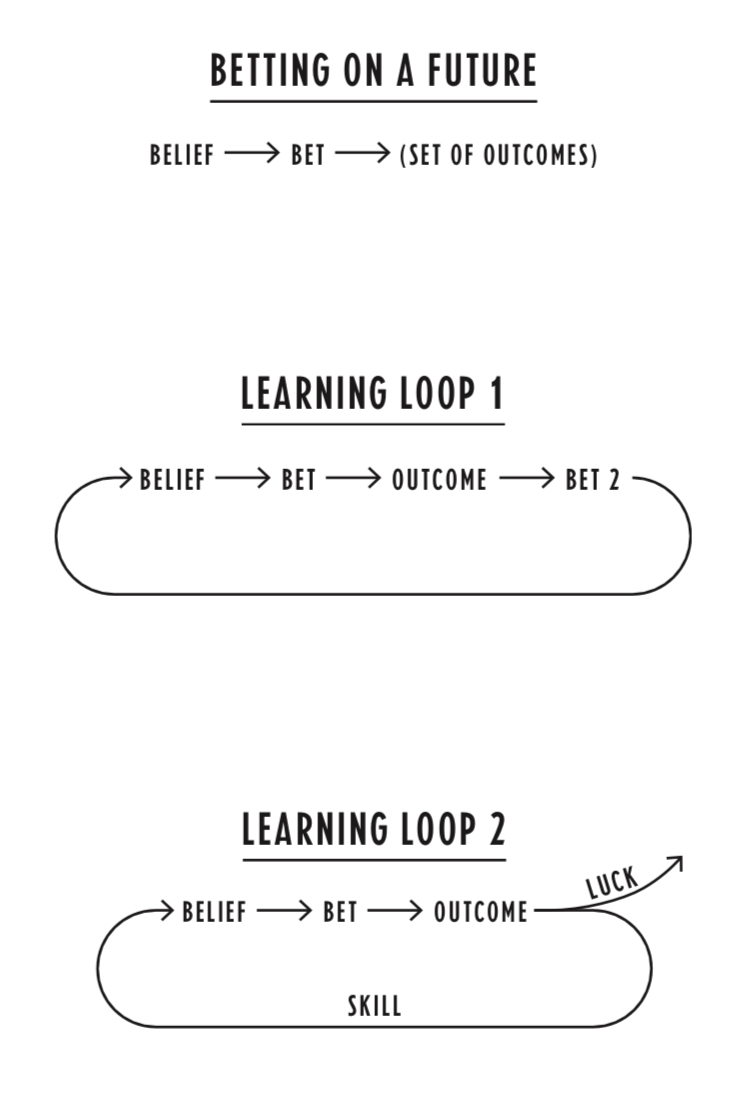
- Use experience to improve beliefs / values going forward
- Have to determine if feedback is a result of decision or just luck
- Self-serving bias: take credit for good things, deflect blame for bad things
- Main ingredients for happiness: 1) income, 2) health, 3) good marriage, 4) lack of tragedy or trauma
- Objective circumstances, demographics, life events only 8-15%
- Never take extreme positions
4: The buddy system
- Decision pod: a trusted group to bounce potential decisions off of
- Accountability improves decision making
- Need people with diverse viewpoints to fill in our blind spots
- Red team / devil’s advocate
- Be aware of your biases and avoid echo chambers
5: Dissent to win
- Share data to allow others to extract insight with the highest fidelity
- Evaluate data independent of its source (don’t introduce bias)
- When describing a process / decision, leave out the result to objectively evaluate
- Avoid the language of no: state points of agreement, follow with “and”, not “but”
- Ask if someone wants to vent or is truth seeking (wants advice)
- 10/10/10: evaluate decision/outcome 10 mins, 10 months, 10 years in the future to get perspective (mental time travel)
- Zoom lens (focusing on current moment) magnifies and distorts, warps decisions
- Backcasting: imagining a desired future and working backwards for actions taken
- Pre-mortem: imagining undesired future outcomes, working backwards to avoid
- Open space for dissenting opinions
- Hindsight bias: tend to overestimate likelihood of outcome after it occurs
18- Thinking in Bets