Thinking, Fast and Slow
Daniel Kahneman2011
- Length
- 20h 2m~528 pages
- Read
- Mar 15th - Apr 6th '21
Summary
The human brain has two systems of thinking (system 1: automatic, system 2: conscious) which are constantly fighting over control of your behavior and actions - resulting in a wide variety of cognitive biases that lead to errors in memory, judgment and decisions. Kahneman details a variety of biases, though perhaps the most critical is attribute substitution wherein a hard question is replaced with an easier heuristic attribute that increases cognitive ease. Loss aversion leads us to avoid taking risks. Duration neglect / peak-end rule suggests we should go after peaks in life (experiential), not aggregate enjoyment (materialism).
“The central fact to our existence is that time is the ultimate finite resource, but the remembering self ignores that reality. the neglect of duration combined with the peak-end rule causes a bias that favors a short peak of intense joy over a long period of moderate happiness. The mirror image of the same bias makes us fear a short period of intense but tolerable suffering more than a longer period of moderate pain.”
Key Takeaways
- Be aware of mental shortcuts, leverage against others (attribute substitution, cognitive ease)
- Seek short peaks of intense joy over long, moderate happiness (peak-end rule)
- Make good first impressions, maintain put-together appearance (halo effect)
- Be systems-oriented, not results-oriented. Game of probability (outcome bias)
- Understand bias to assign logarithmic value to money / assets (prospect theory)
Important Terms
- Attribute substitution:
- Halo effect: Importance of first impressions, outward appearance
- Anchoring effect:
- Availability bias:
- Outcome bias: Results-oriented vs systems-oriented
- Planning fallacy: Tend to assume best case
- Prospect theory: Logarithmic value to money / assets
- Loss aversion: Hate losing 2x as much
- Duration neglect / peak-end rule: Enjoyment determined by peak, not total
- Focusing illusion: Judgement based on small factor
- Can’t simply determine happiness level
Notes
Part 1: Two Systems
- System 1: Fast, have little control
- System 2: Slow, conscious, reasoning
- Pupil dilation = mental effort
- Physical + mental effort related (sprinting)
- Generally lazy, prefer system 1 despite possible bias.
- Self control = better utilization of system 2
- We are subconsciously “primed” by previous events / thoughts (powerful)
- Cognitive ease: gives impression of familiarity (eg. repetition)
- Good mood → creativity, greater ease
- Halo effect: Tend to make assumptions of people’s unknown characteristics based on known attributes
- Thus first impressions are incredibly important
- Mental shotgun: ideas related to topic randomly pop up (overthinking)
- Substitution: translating problem to related one with more cognitive ease, then intensity matching to relevant answer
Part 2: Heuristics and Biases
- Small sample sizes produce more outliers
- The brain finds fake patterns in randomness
- Anchoring effect: an introductory number sways subsequent guess (eg. house price)
- Availability bias: things that more easily come to mind deemed more common (eg. every worker claims to do most work)
- Things regress to the mean, but we like to like to introduce other possible causations
Part 3: Overconfidence
- Econs vs humans (ideal vs real)
- Changed thoughts replace old ones (hard to see how you used to see otherwise)
- We overestimate the predictability of things
- Outcome bias: judging past decision based on outcome that is now known
- Simple formulas always outperform experts who are overconfident in their edge
- Broken leg rule: use judgement over formula exceedingly rarely
- We often judge the same situation differently without knowing (priming)
- Statistics routinely discarded when it doesn’t fit personal impressions
- Planning fallacy: tend to assume best case when planning
- Optimistic bias: optimistic, overconfident, risk taker
- Overconfidence is valued in society
Part 4: Choices
- Utility theory (economics)
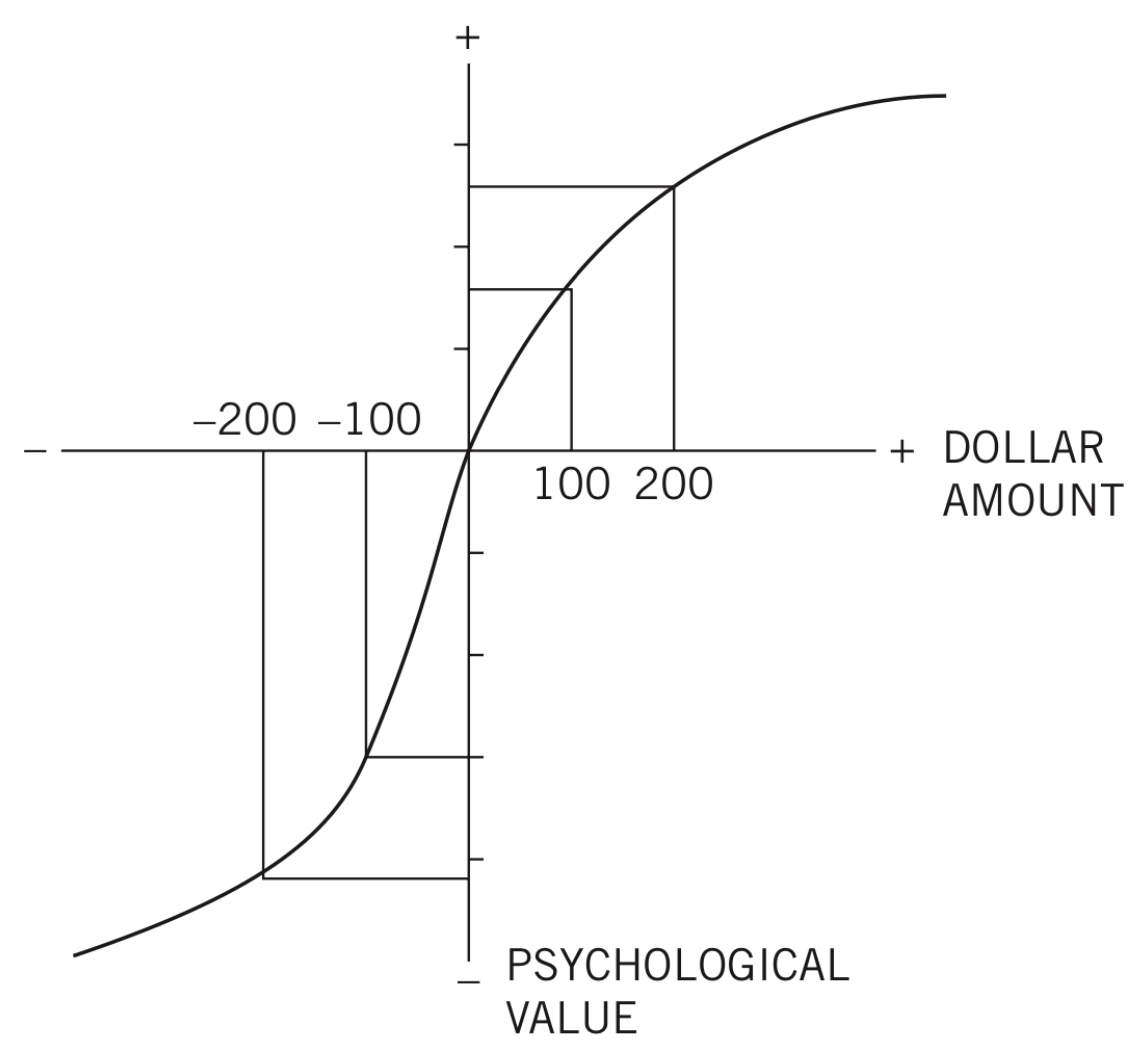
- Prospect theory: we place a logarithmic value to wealth (eg. rather guaranteed $46 than 50/50 0 or $100). However, important to consider frame of reference (eg. already rich, gaining or losing)
- Become more willing to take risks if trying to cut losses
- Loss aversion: we hate losing (things or events), prefer status quo
- Endowment effect: Because of ↑ (reference point), sell price can be >> than buy price
- Value owned goods more than we should, unowned less than we should
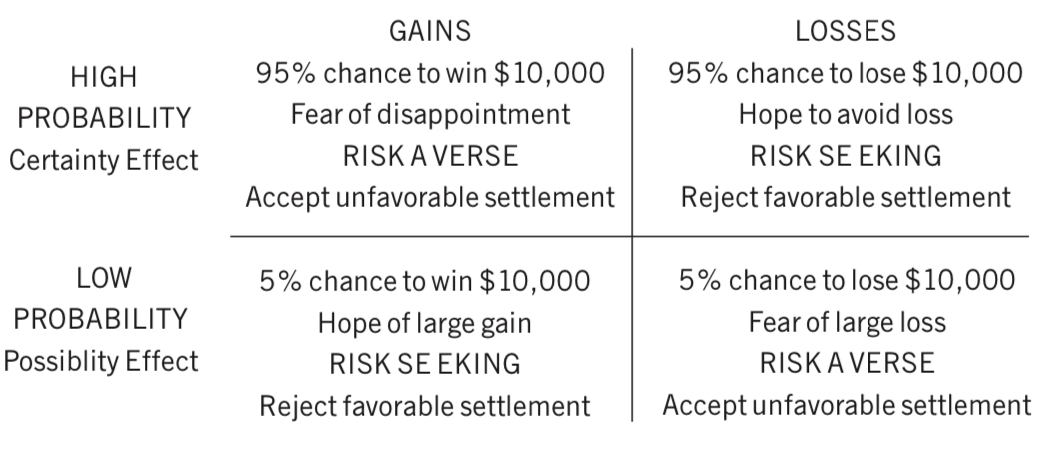
- Possibility effect: Highly unlikely outcomes weighted > deserved (10% → 18.6%)
- Certainty effect: Highly likely outcomes given less weight (90% → viewed as 71.2%)
- Denominator neglect: 1 out of XX,XXX vs 0.00X percent → visualize bad vs good
- Have a risk policy: Take the long term view
- Sunk cost fallacy
- Joint evaluation: Often more objective (vs intensity matching) but can be used to sway judgement, reverse opinion
- Framing (word choice)
Part 5: Two Selves
- Duration neglect / peak-end rule: Memory determined by peak enjoyment, ending rather than duration, total enjoyment (integral)
- Experiencing self vs remembering self
- U index: % time in unpleasant state
- >$75k: no added happiness in life: inability to enjoy small pleasures in life
- Life satisfaction subconsciously boils down to more available (recent) aspects
- Setting goals is incredibly important to future success
- Focusing illusion: Judgement based on small factor (eg. CA weather)
- Disability → not relevant after a while