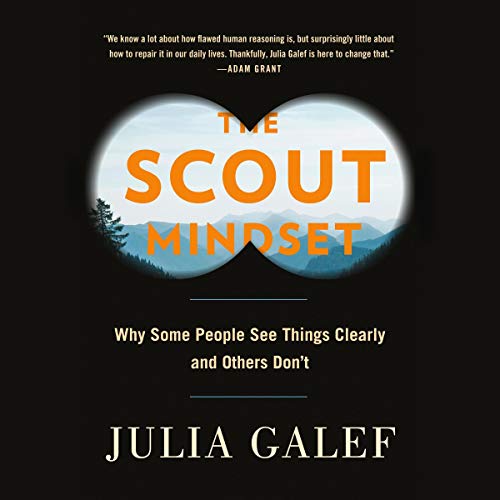
The Scout Mindset
Julia Galef2021
- Length
- 6h 26m~288 pages
- Read
- Oct 20th - 25th '26
Summary
Julia Galef argues that scout mindset, seeing things as they are rather than as you wish they were, serves your goals better than defending comfortable beliefs. Motivated reasoning persists because it protects self esteem, morale, and belonging, and intelligence can make you better at it. he alternative requires nticing when your jugments change with yur motivations, testing your certainty against what you would actually bet, and seeking critics who can help you prove yourself wrong. Galef’s case is that you can face an accurate picture of the odds without giving up resilience or the motivation to act.
That becomes easier when changing your mind feels like refining your understanding rather than admitting a personal defeat. Investigating confusion and listening to reasonable people who disagree with you can expose evidence you would otherwise dismiss. But those habits are harder to sustain when beliefs become your identity. Holding that identity lightly, acknowledging weaknesses on your own side, and learning to argue the other side fairly make revision less threatening. The aim is intellectual honor, putting truth above ego, so that being happy and realistic becomes a practice rather than a tradeoff.
“More and more it’s a scout’s world now”
“if you had to pick one thing for me to improve on, what would it be?”
“People judge you on social confidence, not epistemic confidence”
“The courage to stare reality in the face”
Chappy’s Review
My kind of book! A helpful guide to reasoning more objectively – zooming into a part of the bigger picture. Lots of details around a specific cognitive topic with frameworks and lists!
Key Takeaways
Notes
Introduction
- Scout mindset: see things as they are, not how you wish they were
- 3 prongs:
- Realize that truth isn’t in conflict with your other goals
- Learn tools that make it easier to see clearly
- Appreciate the emotional rewards of scout mindset
Part I: The Case for Scout Mindset
1. Two Types of Thinking
- Motivated reasoning: can I accept this? → must I accept this?
- Scout vs soldier mindset
- Welcome the truth, even if it’s painful
2. What the Soldier Is Protecting
- Chesterton’s fence: understand why it is the way it is before you advocate changing it
- 6 benefits of motivated reasoning:
- Comfort: sour grape + sweet lemon
- Beliefs that protect ego
- Self esteem: intentional self-deception to convince others
- Morale:
- Persuasion: reality distortion
- Image: identity
- Belonging: fitting in / social cohesion
- Eg. friends jumping off bridge → there was probably a fire (good thing)
3. Why Truth Is More Valuable Than We Realize
- We make tradeoffs (eg. between judgement and morale)
- Rational irrationality hypothesis:
- Epistemic vs instrumental (acting effectively to achieve your goals)
- Eg. overestimating social costs
- Eg. not being fully honest with the doctor
- “More and more it’s a scout’s world now”
Part II: Developing Self-Awareness
4. Signs of a Scout
- More intelligent people are more skilled at motivated reasoning
- Do you tell other people when you realize they were right?
- Force feedback: “if you had to pick one thing for me to improve on, what would it be?”
- Do you ever prove yourself wrong?
- Do you take precautions to avoid fooling yourself?
- Eg. natural / unbiased prompting
- Do you have any good critics?
- Can you point to some occasions when you were in solider mindset?
5. Noticing Bias
- 5 thought experiments to explore counter factual reasoning:
- Double standard test: if roles / situation reversed?
- Outsider test: “if a new CEO came in today…”
- Conformity test: imagine they say, “nvm, just playing devil’s advocate” - would you still believe?
- eg. “yes man test” by pretending opposite view, seeing who agrees, then asking them to advocate for it after revealing reversal (Obama)
- Selective skeptic test:
- Imagine it’d argued the opposite and investigate like a skeptic
- Status quo test: imagine what you’re proposing was already the status quo. Would you propose moving back?
- Eg. moving to a city for a new role
- ↑ reveals that your reasoning changes as your motivations change
6. How Sure Are You?
- 100% certainty almost always false
- Get a feeling for perfect calibration
- Claims (marketing) vs bets (skin in game)
- “What can I get away with” vs “how would I bet if something was at stake”
Part III: Thriving Without Illusions
7. Coping with Reality
- Resilience is a healthy form of motivated reasoning
- Belief that you’re doing your best
- Healthy examples:
- Make a plan
- Find silver lining
- Focus on a different goal
8. Motivation Without Self-Deception
- Self-deception + persistence vs an accurate picture of the odds
- Eg. Musk acknowledging 10% chance of succeeding (EV)
9. Influence Without Overconfidence
- Epistemic confidence:
- Social confidence:
- “People judge you on social confidence, not epistemic confidence”
- 3 rules for expressing uncertainty:
- Show it’s justified
- Uncertainty in world > in self
- Give informed estimates
- Focus on a plan + recommendation
Part IV: Changing Your Mind
10. How to Be Wrong
Superforecasting - constantly refine expectations / opinion
- Must view changing your mind as an an incremental shift rather than being wrong - world as shades of gray
- Being wrong = opportunity to hone your technique
- Domain general lessons: how your own brain works, how the world works
- eg. recency bias
- “I was wrong” → “that was wrong”
- Don’t tie identity to belief
11. Lean In to Confusion
- Don’t dismiss others’ irrational actions - lean into the confusion and investigate
- Paradigm shifts
The Structure of Scientific Revolutions
- Tally up existing contrary evidence rather than dismissing one by one
- Lean into confusion - okay to leave it unresolved for years even
12. Escape Your Echo Chamber
- Listen to people you find reasonable but disagree with
- Start with where you agree / how you are allies
Team of Rivals
- We misunderstand each other
- 30 sec argument inherently collapses nuance
- Bad arguments inoculate us against good arguments
- Our beliefs are interdependent
- Changing one requires evolving the others
- Eg. it’s not possible to cause harm if you’re well intentioned
Part V: Rethinking Identity
13. How Beliefs Become Identities
- Eg. religion and politics
- Bayesians vs frequentists
- Signs of identity:
- “I believe”
- Getting annoyed when an ideology is criticized
- Defiant language
- Gaate keeping
- Schattenfreude (joy in others’ suffering)
- Epithets / name calling (people > ideas)
- Don’t attach your identity - it’s easier to update your beliefs that way
14. Hold Your Identity Lightly
- Know where you differ from the generic belief holder for components of your identity
- Ideological Turing test: can you argue the other side well enough that others can’t tell you apart from a believer
- It’s hard to convince someone else when you see / frame yourself as intellectually superior
- Acknowledge the weaknesses on your side
15. A Scout Identity
- “I should” → “I’m the kind of person who”
- Skeptic as identity
- Who do you surround yourself with?
- It’s a sign of intellectual credibility to not always be certain
- “The courage to stare reality in the face”
- Intellectual honor: putting the truth above your own ego
Conclusion
- You can be happy and realistic
- Ideas for scout mindset:
- Ask what biases are effecting your judgement
- Check your “certain” claims
- Worry → make a plan if it came true
- Find a news source who thinks differently from you who you find reasonable
- Get curious when you disagree with someone - why do they believe it?
- Find a caveat or exception to your belief
- Reach out to someone in the past who you disagreed with and say what you’ve learned
- Ideological Turing test
- Be proud of yourself for noticing your own motivated reasoning