The Narrow Corridor
Daron Acemoglu2019
- Length
- 23h 44m~576 pages
- Read
- Jul 3rd - 20th '25
Summary
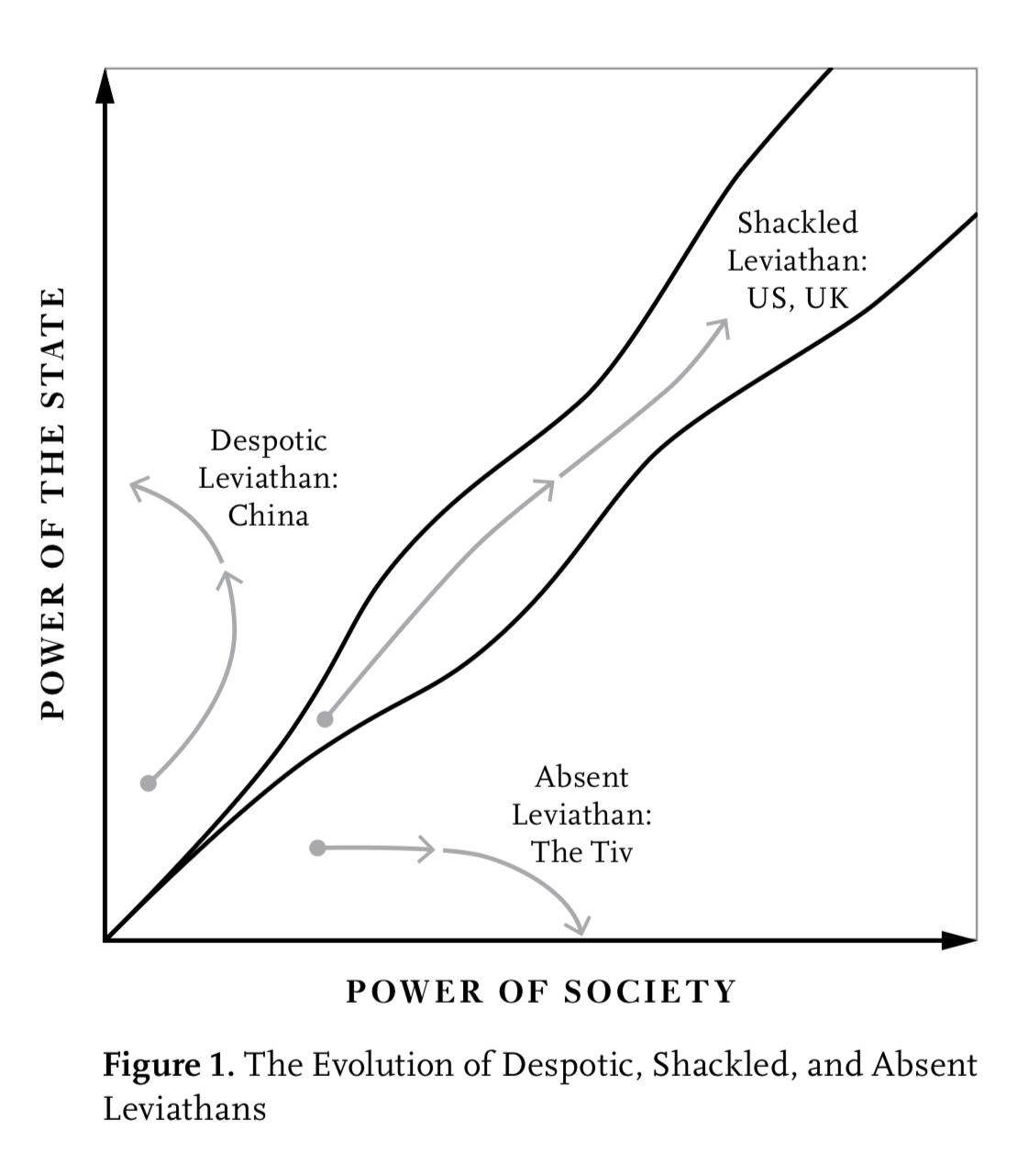
Acemoglu argues liberty requires navigating a narrow corridor between two dangers: stateless anarchy (~25% murder rate over 50 years) and despotic Leviathans (Nazis, Mao). The key is a shackled Leviathan – a powerful state constrained by equally powerful society through the Red Queen effect (state and society racing to balance each other). Pillars include equality before the law, transparency, and broad participation in governance.
“A nation needs a balance between powerful centralizing state institutions and an assertive, mobilized society able to hold its own against the state's power and shackle its political elites.”
Key Takeaways

Notes
Preface
- Liberty throughout history
- Liberty: freedom of possessions, choice and without dependence on others
- Central argument: state and society must be strong for liberty + prosperity
- ↑ balance is “the narrow corridor”X
1: How does history end?
- Fukahama: “the end of history”: democratic capitalism
- Harari: AI → digital dictatorship
- Liberty: the absence of dominance (and also hierarchy?)
- ~25% chance of murder across 50y life in stateless societies (Pinker meta analysis)
- Hobbes: need to have an all-powerful state to prevent anarchic war (absent leviathan)
- Nazis + China famine → fear, dominance of the state / despotic Leviathan
- Balancing laws and norms
- Must be “a shackled leviathan”
2: The red queen
- Greece balance of elites and common folk
- Most important: equality before the law
- Hubris law: can’t defame anyone
- Institutional reforms must work on top of existing norms
- The red queen effect: a situation where you have to keep on running just to maintain your position
- Threat of ostracism for elites
- Pillars of shackled leviathan:
- State builders
- Societal mobilization (involvement of society at large, institutionalized and non-institutionalized)
- Collective action problem: society is full of free riders or unaware
- Society, state should be “legible” (transparent)
3: Will to power
- Niche’s will to power →
- Need an edge for state formation: religion, technology, charisma
- Must break down existing norms to allow state creation
- Need perfect initial conditions for shackled leviathan formation
4: Economics outside the corridor
- Need secure property rights for economy
- Norms of egalitarianism generally needed for state maintenance, peace
- Laffer curve: inverted U of taxation, disincentivizing work when too taxed
- Despotic leviathan likely to still encourage growth, keep taxes low
- Innovation requires creativity, liberty
- Despotic is fragile at best due to continued temptation to take advantage of
5: Allegory of good government
- Italian oligarchic communes
- Communal gov’t (“the 9”)
- 2-month terms
- Needed to break norms of no interest on lending to spur financial system, growth
- Origins of prosperity, economic growth:
- Incentives to invest, experiment, innovate (property rights)
- Broad-based economic opportunities
- Underpinned by public services
- Fair conflict resolution (justice system)
6: Europe: the European scissors
- Two reasons for Europe shackling:
- Takeover of democratically organized tribal societies with norms of consensual decision making
- Participatory norms from Germanic tribes
- Legacy of critical elements of state institutions and political hierarchy from Rome and Christian church
- Takeover of democratically organized tribal societies with norms of consensual decision making
- Franks early ↑
- Norms strengthened to laws
- Laws → resolution of conflict to state
- English critical early features:
- Parliament
- Kings under the law
- More to rationalize existing norms than to impose unilaterally
- The Magna Carta
- High participation by locals in gov’t (3-10%)
- Byzantine empire → despotic leviathan
- Popular contention: how common people organize collectively to influence gov’t
- Increasingly large scale coordination
- Why Europe?
- Fortuitous balance of the 2 blades ↑
- “A nation needs a balance between powerful centralizing state institutions and an assertive, mobilized society able to hold its own against the state’s power and shackle its political elites”
7: China: mandate of heaven
- Chinese had no concept of society having a say versus gov’t (despotic from the start)
- Core tenants of chinese gov’t:
- Monarchic rule by omnipotent emperor: above the law, society no say
- Gov’t should be staffed by people of talent
- Emperor should be concerned with the welfare of the people, constrained by moral precepts
- Legalism vs Confucianism
- Meritocracy → corruption in late 1800s
- No labor associations (except salt)
- No free media
- Lineages too powerful (27+ generations)
- Large state-owned enterprises
- Main challenge of China’s despotic growth: doesn’t allow true experimentation → innovation
- Social credit system
8: India: broken red queen
- India’s persistence of the caste system prevents a strong society → division of laborers
- No Hindu society - only towards caste
- Some states in India over-centralized and massively under-resourced
9: European diversity: devil in the details
- Impact of structural factors
- Must account for initial conditions
- Switzerland vs Prussia vs Montenegro
- “War made the state, and state made war”
- Black Death → increased power of society
- Soviet breakup divergent results
- Costa Rica vs Guatemala
- Thus, there will be no “end of history” since every country has its own history
10: US: what’s the matter with Ferguson?
- Society is strong relative to state → inequality, hard to provide broad-based public services
- Bill of Rights doesn’t apply to states
- Separation of powers prevent state institutions from capture by common people
- Public-private partnerships
- Eg. postal service
- Eg. legal: class action lawsuits
- Prevents gov’t overreach
- Inherently less equitable
- Federal-local partnerships
- ↑ success in shackling, but also downsides
- Progressive era → power to society
- Racial segregation
- Defense (NSA, FBI) dangerously developed outside the purview of society
11: Latin America: the paper leviathan
- Shackled + absent leviathan
- Paper leviathan: look like a state, but lack the power
- Two reasons:
- Mobilization effect: worried about mobilizing an opposition
- Discretionary use of power is a tool (corruption, appointments)
- Why? Residues of colonization
- Colonizers intro’d state institutions without societal control
- Done cheaply + remotely without meritocratic appointment
12: The Middle East: Wahhab’s children
- Intensified cage of norms
- Prevents conflict
- Prevent destabilization of status quo
- 3 reasons:
- Islam: anyone with sufficient knowledge can interpret meanings
- Koran is open to interpretation for power vested to leaders (leeway)
- Hobbesian view
13: Nazi Germany: red queen out of control
- Emerged from lack of trust and function in state institutions
- Reasons:
- Polarization between state and society
- Inability of institutions to contain and resolve conflicts
- Shocks destabilizing institutions, deepening discontent
- Populist movements inevitably lead to despotism
14: Into the corridor
- 3 critical factors:
- The ability to form coalitions that support such a transition
- The location of current balance of power b/w state and society
- The shape of the corridor
- Factors shaping the corridor:
- Labor coercion, eg. forced low-wage labor vs unions
- Globalization
- International relations, human rights
15: Living with the Leviathan
- State vs market
- State
- Managing externalities
- Public goods
- Pervasive asymmetric information
- Monopolies
- Income redistribution
- Market
- Allocating resources
- Must keep in mind balance of power whenever implementing new policies
- Current issues in the US
- Increasing inequality
- Disappearing jobs
- Outsourcing + automation
- Finance sector
- Economic concentration
- Supersized companies
- Winner-take-all dynamics
- Low societal trust in institutions
- Low transparency
- US solutions:
- Transfer power to the states
- Public-private partnership
- Improve ability to monitor the state
- New labor market institutions
- End the revolving door
- Make civil service more autonomous
- End lobbying
- Less ability for current admin to appoint civil service positions
- Fix redistricting
- Increase in mobilization of society
- More civic associations
- Universal basic rights