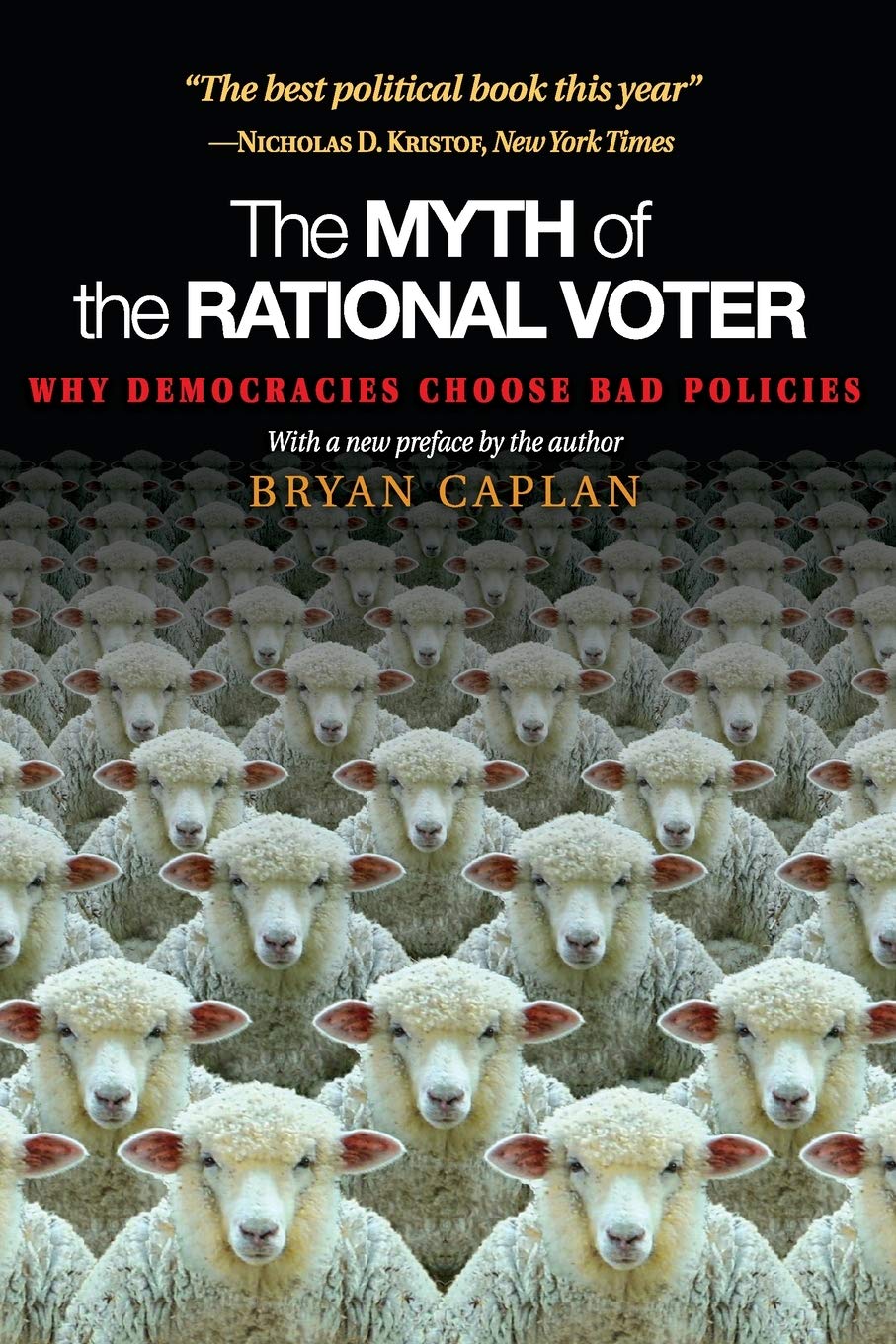
The Myth of the Rational Voter
Bryan Caplan2007
- Length
- 8h 44m~280 pages
- Read
- Apr 4th - 8th '23
Summary
Voters are ignorant and systematically biased in predictable ways: anti-market, anti-foreign, make-work, and pessimistic. Unlike rational ignorance (where random errors cancel out), these biases compound because voters share the same wrong beliefs. Rational irrationality explains why: when the personal cost of a false belief is near zero (one vote never decides an election), people indulge emotionally satisfying beliefs over accurate ones. Democracy doesn't fail because voters are selfish – it fails because they are sincerely wrong. The fix isn't more voting – it's economic education.
“A wise man learns more from a fool than a fool learns from a wise man.”
“Irrationality, like ignorance, is selective.”
“One vote has so small a probability of affecting electoral outcomes that a realistic egoist pays no attention to politics. He chooses to be rationally ignorant.”
Key Takeaways
Notes
Introduction
- “Irrationality, like ignorance, is selective”
- Irrational voter is empirically proven
- Human motivation → irrationality rational
- Irrationality is needed for a realistic view of democracy
- Built-in externality
1: Beyond the miracle of aggregation
- “One vote has so small a probability of affecting electoral outcomes that a realistic egoist pays no attention to politics. He chooses to be rationally ignorant”
- Wisdom of crowds
- Miracle of aggregation: “An almost completely ignorant electorate makes the same decision as a fully formed electorate”
- Systematic bias/error
2: Systematically biased beliefs about economics
- Systematic misunderstandings of government spending per sector
- Anti-market bias: underestimate ability to harmonize private greed, public interest
- “The study of his own advantage… necessarily leads him to prefer that employment that is most advantageous to the society”
- Prejudice against debt markets (loans)
- Monopoly vs scarcity, wage fixing
- Anti-foreign bias: underestimate benefit of interaction with foreigners
- Comparative advantage
- Make work bias: equate prosperity with employment, not production
- Luddite mentality
- Pessimistic bias: prone to thinking conditions are getting worse
- Loss aversion + lack of perspective
3: Survey of Americans on economy
- 2000: 6% of economists against free trade
- Disconnect between economists, Americans
- Layman-expert belief gap
- <=20%: self-serving, ideological bias
- 80%: experts’ greater knowledge
- One explanation: time horizon
- Only thing economists more worried about: “business productivity growing too slowly”
- Miracle of aggregation is false
4: Failure of rational ignorance
- Bayes’ rule allows for rational yet biased or incorrect beliefs
- Asymmetric information
- Can be well-informed by using trusted resources, relying on party labels
5: Rational irrationality
- Conflicts of truth seeking:
- Being rich (special interest money)
- Being liked (conformism)
- Religion / values (mix cognitive motive)
- Preferences vs beliefs, false beliefs
- Double think: holding two contradictory thoughts and believing both of them
- Rational irrationality: weighing emotional benefit of belief with cost of error
- Monetary bets force rationality
6: From irrationality to policy
- Voters are not selfish
- Belief gap: (by disagreement level)
- Education: 50% (highest vs lowest)
- Income: 36% (going up vs not)
- Job security, being male: ~20%
7: irrationality, and the supply side of politics
- Politicians are masters of rhetoric
- Striking optimal balance between being right and being popular
- Delegation: lack of oversight = trust
8: Market fundamentalism vs the religion of democracy
- Religious fundamentalism
- Market fundamentalism
- Democratic fundamentalism
- Adverse selection problem
- Fixes for democracy:
- Political literacy test to vote
- ↓ efforts to increase voter turnout
- More education
- Change the curriculum*
- More objective politicians, influencers
- Economists should hammer home bias
- Steven Pinker: cognitive tools, most important, grasping the modern world, most unlike cognitive tools they are born with
- Economics, evolutionary biology, probability and statistics