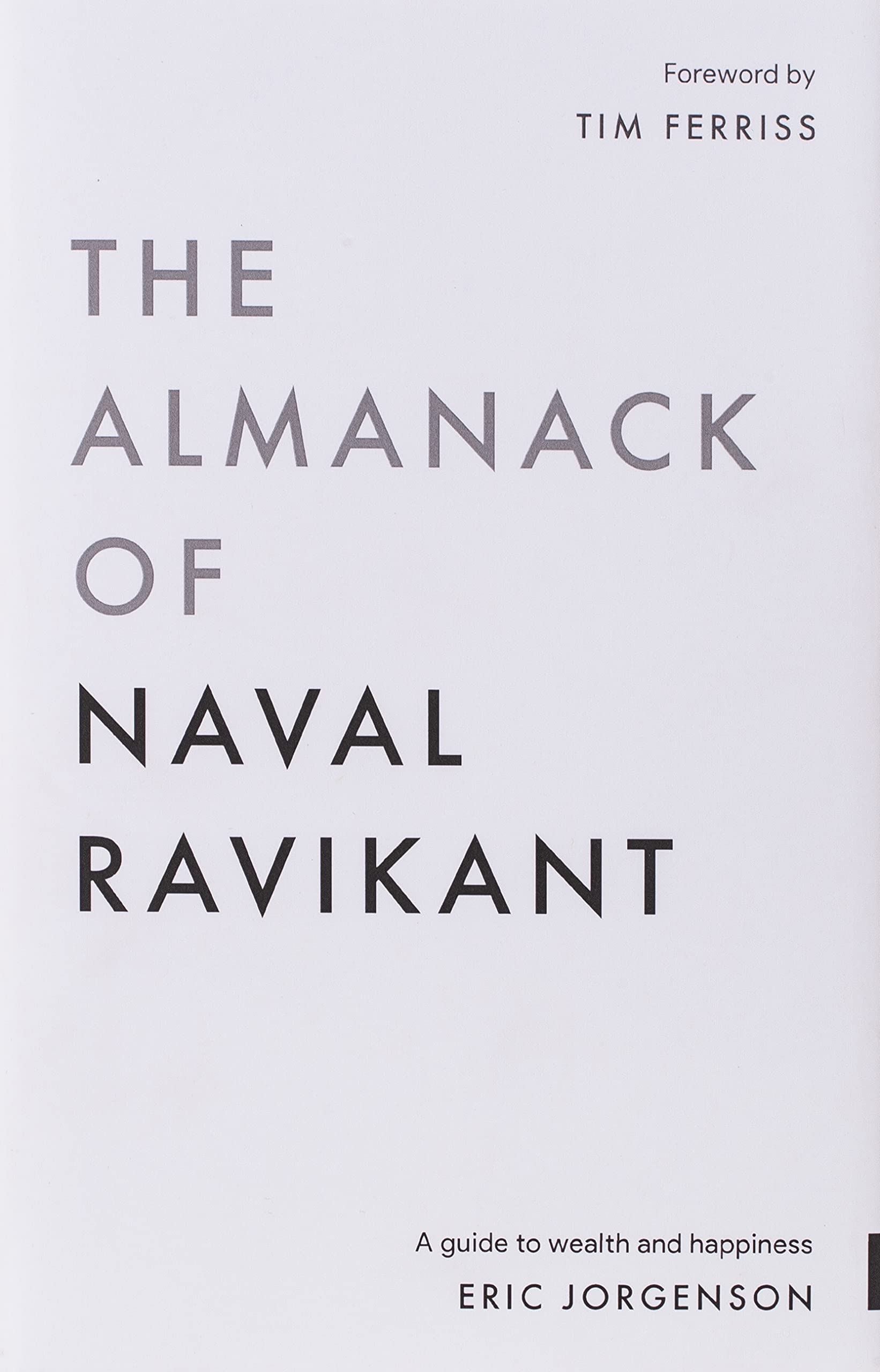
The Almanack of Naval Ravikant
Eric Jorgenson2020
- Length
- 8h 27m~242 pages
- Read
- May 20th - Jun 8th '26
Summary
The Almanack of Naval Ravikant condenses Naval’s principles for building wealth, judgement, and freedom. Wealth comes from seeking equity rather than status, developing specific knowledge, taking accountability, and applying leverage through labor, capital, code, media, products, and personal platforms. The goal is not money for its own sake, but independence and the ability to affect the world.
The book’s second half frames happiness as a trainable skill rooted in presence, desirelessness, habits, and values. Naval emphasizes meditation, strategic indifference to what cannot be controlled, choosing the right people, remembering death, and living by personally selected principles. His operating system combines practical wealth creation with Rational Buddhism, long-term thinking, health, relationships, and mission.
"Seek wealth, not money or status"
"Happiness is the absence of desire"
"Health, love, and your mission in that order. Nothing else matters."
Key Takeaways
Notes
1: Wealth
Building Wealth
- “Seek wealth, not money or status”
- “If you secretly despise wealth, it will allude you”
- Compound interest
- Arm yourself with specific knowledge, accountability, and leverage
- Knowledge you cannot be trained for (apprenticeships, not school)
- Outsource everything below your hourly rate
- Productize yourself
- Scale with labor, capital, code, media
- Money = social credit
- Sci fi = you absorb a lot of information very quickly
- “The best jobs… are creative expressions of continuous learners in free markets”
- T-shaped
- 99% of life is wasted energy (in a goal-directed sense) - cut as soon as you know
- Own equity
- Capital > labor as a cleaner, more modern form of leverage
- …but code / product and media are even better, more modern
- Optimize for independence > pay
- The more creative a role, the more disconnected inputs and outputs are, the more lumpy + independent work is
- Paid based on judgement, not work
- Set a very high aspirational rate for yourself and stick to it ($1k-5k+)
- Get out of a relative mindset - positive sum; don’t despise others’ wealth
- Status is zero sum, wealth is positive sum
- Lusting for money is a bottomless pit
- 4 kinds of luck:
- Blind luck: fortune, fate
- Persistence, hustle, motion
- Good at spotting luck
- Build a brand where luck finds you
- “Sharks live well but live a life surrounded by sharks”
- Be patient
- Wealth = the ability to effect the world
- Also includes knowledge / leverage
- “I’m trying to say something true in an interesting way” - get it to resonate, overcome the Lindy effect
- “You must believe in ethical wealth creation” - nature has 6x as many parasites - easier to steal than create
Building Judgement
- Budget 1-2 entire days per week to think clearly
- “Optimistic contrarians are the rarest breed”
- Load your head full of mental models - compact ways for you to recall your own knowledge
- Principal agent problem
- Nassim Taleb “one of the greatest philosopher scientists of our time”: ↑ + black swan events
- Read books
- Start with the basics + originals
- “To become a philosopher king, become a king first” practice > theory; specifics → generalize
- Taste: when your judgement is so good and intuitive you can’t explain it
- “It’s not that AI is going to replace SWEs, it’s that AI is going to let software engineers replace everyone else”
2: Happiness
Learning Happiness
- Happiness in deeply personal, contentment in the moment
- “Happiness is the absence of desire”
- The cravings of things that put us in the present moment prevents us from being present in those moments
- “Would I rather have this thought right now or would I rather have peace?”
- Happiness is a single-player game
- Jealousy is a poisonous emotion
- Choose the 5 people around you
- “Happiness is a skill you develop and a choice you make”
- Meditation = better at understanding your mind, controlling your thoughts
- Tell people you’re a happy person → conformity bias forces you to live it
- When in a funk, force yourself to listen to music and switch tasks
- Keep death front of mind: world won’t remember you or your work anyways
- The more you think about yourself the less happy you’re going to be
- Cultivate a strategic indifference to things outside of your control
- You need to find something you love more than yourself (mission, family, religion etc.)
Saving Yourself
- Combinatorics of human DNA + development → be yourself with intense passion - don’t follow others
- Paleolithic selves
- Diet, workouts, walking
- “Meditation is intermittent fasting for the mind”
- Cold showers taught me most of our suffering comes from avoidance
- Helps you re-learn this every morning
- Meditation: give yourself an hour a day off from life - do nothing and just let thoughts com
- Separate from your crazy monkey mind self
- You become your habits
- Impatience with actions, patience with results
- Learn math, persuasion, study science / truth
- Free yourself
- Be aware you’re a rat in the race - that’s fine
- Almost all advice is simply eschew short-term reward in favor of long-term
- Even altruism (eg. via religion)
- Become a Schelling point for a mission or ideology
- “We need religion because people won’t figure out an operating system for themselves”
- Do we want it to be the state instead? Or corporations?
- Explore vs “invest” (exploit)
Philosophy
- “Anything you do will fade” - blip in cosmic time - live freely
- ↑ you must create your own meaning
- Live by your values
- Selected values:
- Honesty / authenticity - free to be self and not judge
- Peers, not subordinates
- Infinite games
- No angry peoppe
- “Rational Buddhism”
- Keep what’s useful, discard what’s not
- Simulation theory is a lousy theory: won’t change how you live your life
- Matrix white room / enlightened monk analogy
- The best life is 70-80% of many things
Naval’s Recommended Reading
Writing
- Happiness = health + wealth + good relationships
- Health = exercise + diet + sleep
- Income = accountability + leverage + specific knowledge
- Accountability = personal branding + personal platform + taking risk
- Leverage = capital + people + IP
- Be present above all else
- Reading is the ultimate meta-skill
- Praise specifically, criticize generally
- “Truth is that which has predictive power”
- “Greatness comes from suffering”
- “Health, love, and your mission in that order. Nothing else matters.”