The 12 Levers
Jeremy Stevenson, Spencer Greenberg2026
- Length
- 10h 36m~368 pages
- Read
- Aug 2nd - 5th '26
Summary
Techniques are specific, repeatable, controllable procedures that produce change. Nearly all self-help advice collapses into 12 levers: understand causes, clarify and actualize values, prepare for recurring challenges, approach fear, shift physiology, steward thoughts, improve productivity, activate behavior, communicate skillfully, choose your attitude, and direct attention. The system favors accurate diagnosis, values-aligned action, evidence-based practice and small interventions you can actually control.
“Your mind and body are deeply connected. Shifts in your physiology can shift your psychology and vice versa.”
“A person’s success can be measured by the number of uncomfortable conversations they’re willing to have.”
~ Tim Ferris
“The pinnacle of self improvement might be to lose the sense of self.”
Chappy’s Review
One of my new favorite books of all time! An incredibly useful map of “levers” and techniques for self management and self leadership. It really helps to contextualize all of the other self help books I’ve read.
Key Takeaways
Notes
Introduction
- Techniques: specific, repeatable, controllable procedures that aim to achieve certain outcomes
- Useful because:
- You control them (eg. vs emotion)
- They affect change
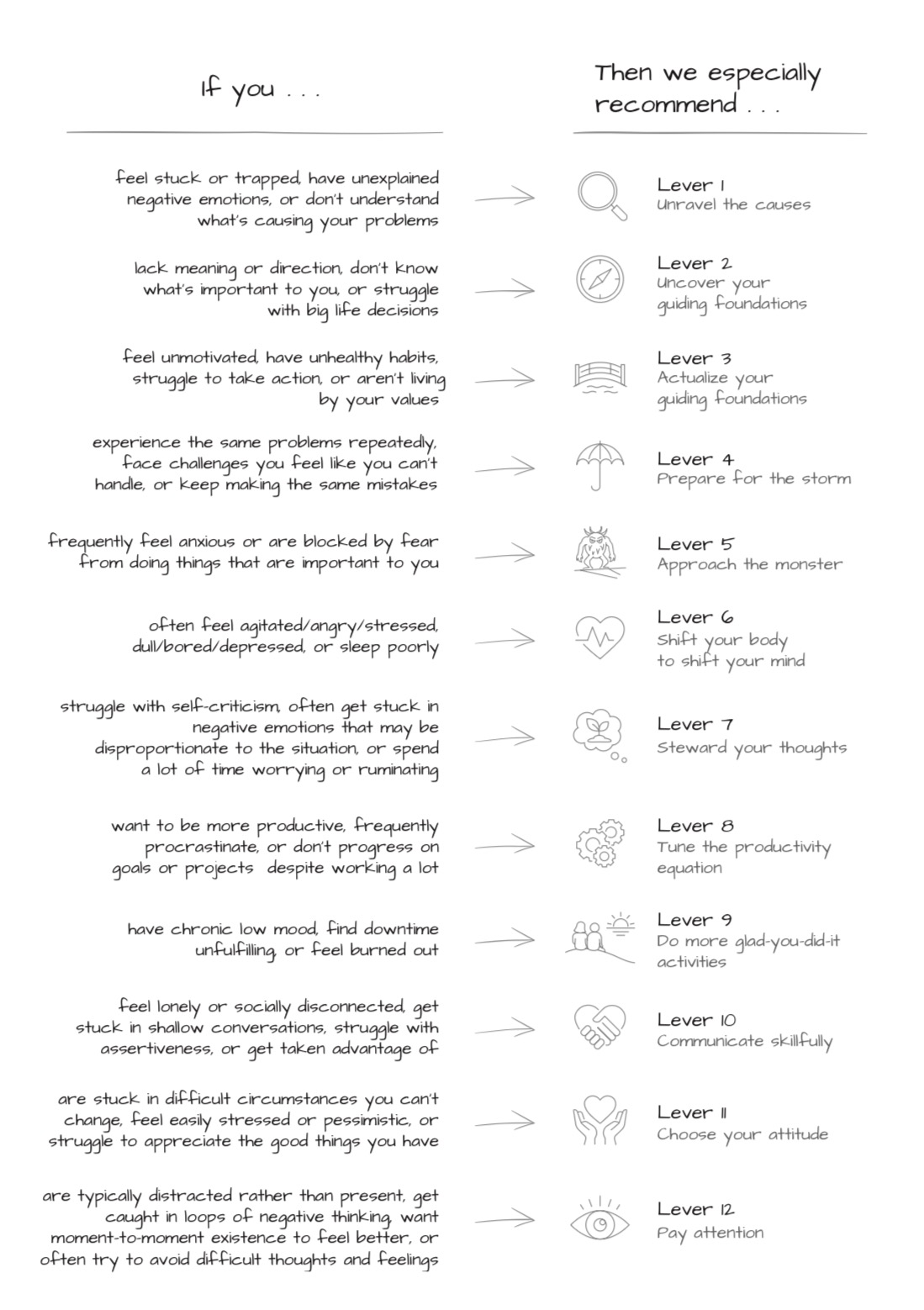
- Premise: all self-help advice collapses into these 12 levers (categories of techniques)
1: Unravel the Causes
- Better understandings leads to better solutions
- ABC analysis: break down into causes
- Activating event
- Beliefs
- Consequences, both emotional and behavioral
- ↑ include background vulnerability factors (eg. childhood, trauma)
- Identify the causal chain
- Inner why: catch yourself when your emotion shifts and ask “why?”
- Can clarify what bothers you and why
- More space between emotion and action
- Bright spot analysis: when something went right / feels good, “why?”
- Short-term background factors, beliefs, emotions, behaviors
- When diagnosing a problem that seems psychological, spend at least a little time on possible non-psychological causes
2: Uncover Your Guiding Foundations
- Clarifying your guiding foundations helps give your life direction
- 3 types of guiding values:
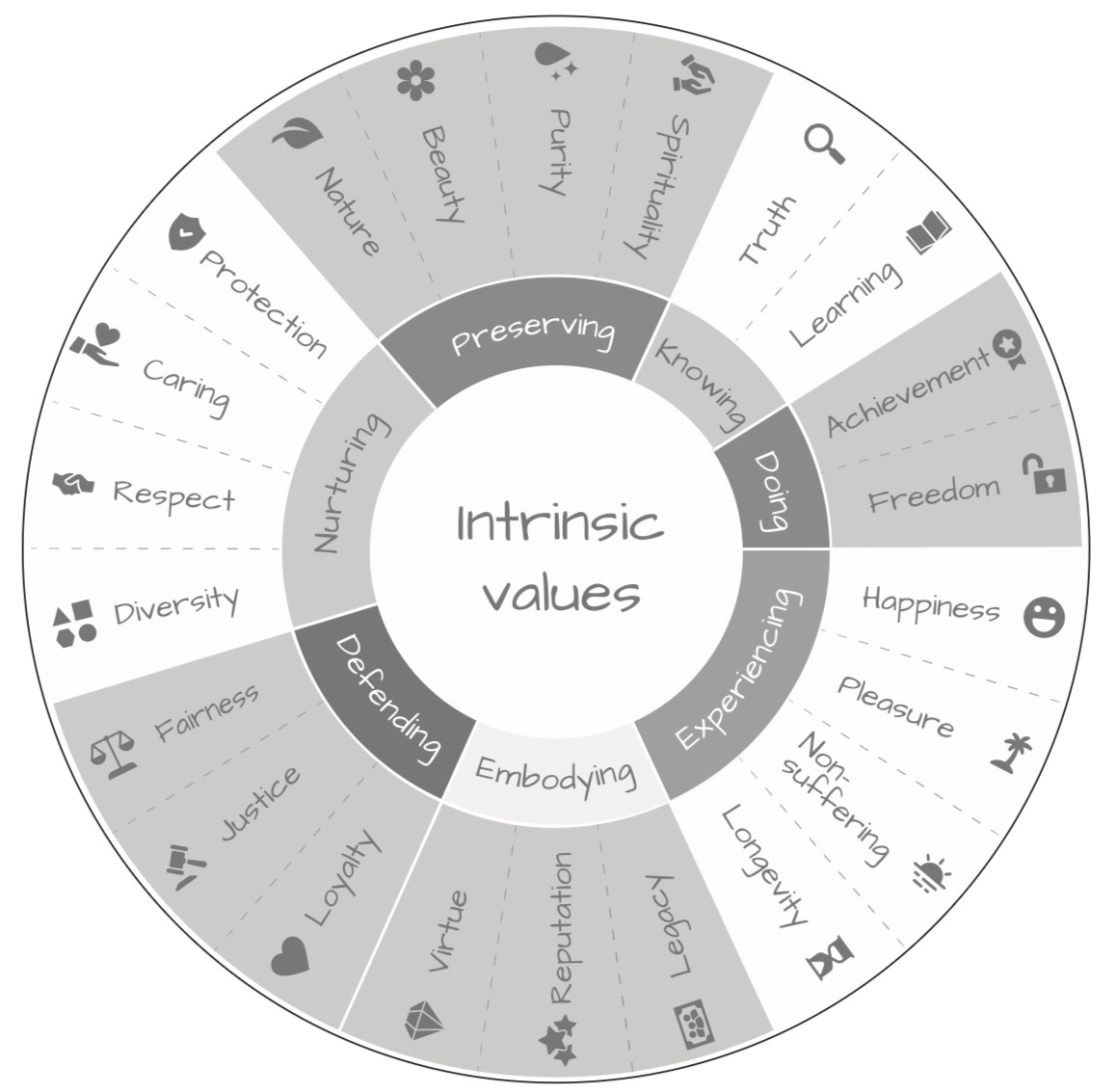
- Intrinsic values: “why”: value for their own sake, even if they get us nothing
- Eg. truth, learning, achievement, loyalty, beauty, happiness
- Principles: “how”: guiding rules you create for your life
- Decide in advance how you want to behave
- Eg. trust people by default
- Priorities: “what”:
- 3 approaches to uncover your values:
- Exploratory questions
- What did you dream of doing as a child?
- Who or what do you admire?
- What triggers strong emotion?
- If the biggest barriers were removed, what would you do?
- If people gave a future speech about you, what would you like them to say?
- Life domains
- In each domain, what do you want to be?
- Existing lists of values
- Wheel of 22 values*
- Review monthly
3: Actualize Your Guiding Foundations
 Essentialism: aligning daily actions with values
- 7 principles for effective goal setting:
- Align with your foundations
- Ambitious yet achievable
- Don’t set too many at once
- Clarify your overarching goal
- Clarify subgoals
- Timeframe
- Clarify which repeated actions will move you towards your goals
- Deliberate practice
- VAST goals:
- Valuable
- Aspirational
- Streamlined (only 1-4 at a time)
- Target
- Habits: the compound interest of self-improvement
- Overcome resistance through pain and pleasure
- Remind yourself of the benefit
- Reward yourself
- Rearrange the environment
- Report your success
- Reduce the size
- Reflect on how you started previous habits to inform how to start new ones
- Identify choice points and move closer vs away from values
- 4 ways to actualize your guiding foundations:
- Goals
- Habits
- Choice points
- Reflection
- Quarterly reviews answering 3 Qs:
- How successful were you?
- What can you learn?
- What’s the plan for next quarter?
4: Prepare for the Storm
- Preparation plans: for when things get bad
- 3 steps to apply to any recurring challenge:
- Recognize risk factors (external)
- Identify early warning signs (internal)
- Develop prevention + coping strategies (if X, then I’ll do Y)
- Generally, do the opposite of your gut action after trigger
- STOP: Stop, take a step back, observe, proceed effectively
5: Approach the Monster
- Fear can develop thru conditioning and generalize unhealthily
- Exposure therapy: most scientifically validated anxiety treatment in the world
- ↑ make your predictions explicit to shift to experimental mindset
- Avoiding anxiety-inducing situations makes brain incorrectly associate with safety - prevents learning to overcome unwarranted fear
6: Shift Your Body to Shift Your Mind
- “Your mind and body are deeply connected. Shifts in your physiology can shift your psychology and vice versa”
- 4 physical strategies:
- Sleep
- 3 main tips:
- Stick to a schedule
- Avoid overstimulation near bedtime
- Get healthy stimulation early in day
- 60-67 degrees best for sleep
- Sun / light therapy crucial
- Sleep restriction
- Relaxation exercises
- Progressive muscle relaxation: goal is to reduce physical tension
- Sit or lie down in a comfortable place
- Close your eyes and take a few short breaths
- Start at bottom of body with toes and tense up for 5 secs, then relax for 10 secs - noticing contrast
- Do with each body part
- Repeat as desired
- Slow breathing: interrupt over breathing which causes anxiety
- SNAPE: slow, nose, abdomen, paced, exhale
- Longer exhales
- Energizing breathing: over breathe to increase alertness
- Inhale with moderate force for 1 sec
- Exhale after no delay for 1s
- Repeat 10x (up to 5 mins)
- Next level: Wim Hoff breathing
- Healthy stress: hormesis thru cold exposure and exercise
- Cold showers (aim for 11m/w)
- Start with cold end to shower
- Dive response: face in cold water and hold breath for 30s slows down heart rate
- 2.5h moderate cardio, 2 strength training sessions per week
- Cold showers (aim for 11m/w)
7: Steward Your Thoughts
7.1: Cognitive restructuring
- Reframing unhelpful thoughts
- Your thoughts change how you feel. Different feelings depending on interpretations
- When you feel strong negative emotions, the thoughts underlying them will often contain exaggerations or distortions
- Not most positive, but most helpful and still accurate
- Reframing process:
- Identify the main distressing thought / belief
- Identify + label cognitive distortions
- Ask reframing questions
- Create an alternative balanced belief
- “What story am I telling myself rn?”
- Anger, anxiety, shame, depression, guilt
- Not facts, preferences, or feelings but thoughts that are:
- Subjective interpretations
- Judgements
- Predictions
- Downward arrow technique: ask “if that’s true, why does that matter?” to uncover deeper beliefs
- 10 cognitive distortions:
- All or nothing / black or white
- Catastrophizing
- Emotional reasoning (> facts)
- Jumping to conclusions
- Labeling
- Magnification / minimization
- Dwelling on the negative instead of balancing with the positive
- Over-generalization
- Personalization (over-assigning self blame)
- Should-ing and must-ing (applying overly rigid standards)
- Reframing questions:
- What is the evidence for and against the belief?
- What would I tell a friend?
- What is the continuum? (not black or white)
- What’s the worst, best, and most likely outcome?
- What are alternative explanations?
- How much responsibility do I actually have?
- Alternative balanced belief: you believe just as much as the old one but it’s more helpful
- Next time it comes up, practice reciting ↑ 10 times
7.2: Parts work
- Communicating with different metaphorical parts of your mind
- Identifying and talking about parts is less overwhelming and threatening
- Parts work: IFS, CFT, Schema therapy
- Benefits:
- Useful metaphor to simplify things
- Creates a healthy distance (eg. “part of me is anxious”)
- Shields your identity in a healthy way (eg. don’t identify with depression)
- Process:
- Identify the triggered part
- What’s the loudest voice / impulse?
- Give it a name, possibly even an age, and visualize
- Eg. needy part, procrastinator, detached protector, people-pleaser, critic
- Activate the compassionate self
- Leader of all parts
- Think of when you’re highest EQ
- Start with a list of qualities and try to embody each one
- Slowly turn into muscle memory
- Engage with the triggered part
- Recognize they’re often trying to protect you
- Connect with it first, then seek to meet emotional needs
- Common problems:
- Flooding (when emotions are too intense)
- Start with breathing or exercise first
- Not knowing what to say
- Try connection, protection, independence, encouragement, play, boundaries, guidance, reassurance
- Start by asking questions, then talk to it in ways that aim to meet emotional needs
- Struggling to connect with the practice itself
- It’s just a framework for improving self talk
- Internal resistance can just be woven into the internal dialogue
- “Yeah this can seem weird. But if it works it works. I don’t really care what it looks like I just want to help us.”
- Flooding (when emotions are too intense)
7.3: Postponement
- Setting aside unhelpful thoughts for a different time
- Everyone has negative thoughts - the problem is when you’re stuck spending hours on them
- Meta-cognitive beliefs: our beliefs about our thinking
- Overthinking becomes a problem when it’s prolonged and chronic
- Common MCBs for over-thinkers:
- Even prolonged overthinking is useful
- Example reframing questions:
- Does ruminating really help you understand things better or does it keep you spinning around the same thoughts?
- Is spending hours worrying actually an effective way to solve problems?
- After a prolonged spiral are you closer to a solution?
- Can thinking too much really make you lose your mind? Has that happened to anyone you know?
- If worrying is uncontrollable, how do you explain times it’s naturally been interrupted? (eg. phone call)
- Negative forms of avoidance: suppression, distraction
- Postponement: can think about this, but not until later
- Eg. daily at 4pm for 15 mins
8: Tune the Productivity Equation
- Based on
Four Thousand Weeks - you’ll never feel permanently on top of everything
- Productivity: how much value your actions create per unit of time
- Productivity = time * efficiency * importance
- Healthy productivity accounts for everything you value, not just one thing (eg. truck driver max speed)
- Importance: pursue the right thing in the first place
- Big picture:
- Value alignment test: score against your guiding values
- Pre-mortem: imagine looking back after your failed project. Why’d it fail?
- Ideally, do with others
- Small picture:
- Daily planning: “what’s the one task I could realistically get done today that’ll most move me towards completing my overarching project or goal?”
- Time:
- Time tracking
- Life admin → outsourcing
- Rule of thumb: hourly salary + 50%
- Efficiency: arriving prepared, managing distractions, overcoming roadblocks
- Breaking tasks down: (even by minute to overcome roadblock)
- Problem solving:
- Define the problem clearly
- Brainstorm solutions
- Pick one
9: Do More Glad-You-Did-It Activities
- Studies: behavioral activation combats depression as much as cognitive / self-talk methods
- Behavioral activation: making yourself do more paradoxically gives you more energy
- Should be “glad you did it” - ie. long-term > short-term rewarding
- Steps of behavioral activation:
- Mood monitoring:
- Build a master list of activity ideas:
- Schedule (weekly?)
- Eg. peak-end rule, impact bias distort
- Categories of actions:
- Mood-monitoring standouts
- Old favorites
- Pleasure
- Achievement
- Avoided
- Values-aligned
- Exercise
- Socializing
- Action often precedes motivation
10: Communicate Skillfully
10.1: Cultivate deeper conversations
- Relationships are the strongest predictor of happiness
- How to build better relationships?
- Pathways to deeper convos:
- Interests: “what are you most excited about these days?”
- Opinions: “how do you feel about that?”
- Ideas: “what are the pros and cons of fame?”
- Highlights / lowlights (access emotion)
- Stories about change / formative experiences
- ↑ vulnerability:
- Doubts, insecurities, weaknesses, fears
- Shame: the pinnacle
- Worthlessness, inadequacy, inferiority
10.2: Improve assertiveness
- “A person’s success can be measured by the number of uncomfortable conversations they’re willing to have”
- Assertiveness:
- Speaking calmly, appropriate eye contact, polite but firm + direct
- Clearly expressing your true feelings and preferences
- Eg.
- “That’s a bit too far man”
- Then, pull aside “I know you were being playful but it’s hard for me to take that as a joke”
- Communication styles:
- Passivity: prioritize others needs over your own
- Assertive: prioritizing your needs and others
- Aggression: your own needs > others
- Bill of assertive rights: all have right to…
- Say no
- Express your opinions
- Make mistakes
- Be treated with basic respect and heard
- Change your mind
- Ask for what you need
- Feel whatever emotions arise
- Take time to make decisions
- Make decisions without explaining yourself
- Say idk or “I don’t understand”
- End conversations
- ↑ helps curb self-limiting beliefs, those prone to aggression
- I > you
- “You” statements often trigger defensiveness, “I” statements prevent accusations + assumptions
- Forcing function to express opinion
- Make effective “you” statements
- Focus on their externally observed behavior > their thoughts, feelings
- Attack action, not person / identity
- Politeness
- Use questions instead of statements
- Propose alternatives
- Provide brief explanations
- Validate their perspective
- Use softening words + phrases
- Tentative, precise, reassuring, vulnerable
- Courteously apologetic
- Amplify if necessary
- Louder
- Broken record
- Reasonable consequences (eg. walk away)
- If it’s a pattern, address the pattern itself: “I sometimes have to express my needs”, see how they react
- Ponder times when you were passive, aggressive, or passive-aggressive
11: Choose Your Attitude
11.1: Optimism
- Optimists view failure / rejection as:
- Temporary (growth / learning)
- Specific (not over-generalized)
- External (system, not all personal)
- ↑ learned optimism
- Fair risks:
- Excessive risk taking
- Failure to learn from mistakes
- Toxic positivity
- Self-deception about what’s true
- Growth mindset: skills and abilities can be improved through effort
- Remind yourself of brain’s impressive adaptational capacity
- Reflect on past successes, skill improvements from hard work
- Always I can’t “yet”
- Write about your best possible self for 20 mins per week (best studied technique)
- How it’d feel in the future if you’d achieved all of your goals
- Begin again - “the past is just a thought in the present”
- Pause, and ask yourself to just begin again
11.2: Acceptance
- “When the worst happens, it is not the end - it is the beginning”
- Acceptance: resetting your psychological baseline for what feels normal
- 5 things we often struggle to accept:
- Things that've happened in the past (eg. trauma)
- Opinions + behavior of others who won’t change
- Things we’re born into (eg. family origin, genetics)
- Global events
- Aging + mortality
- CPT: accept natural emotions, change manufactured emotions
- Identify all the ways you are resisting it
- Release the resistance
- Eg. sitting with it, opening up with others, cutting things off
- Temporal distancing
- Impact bias (loss aversion?)
- Death (makes a mockery of almost everything else we spend our lives doing)
- Unconditional self-acceptance
11.3: Stoic resilience
- Stoicism: resilience as central to living a good life
- Expect hardship so you’re mentally ready when it arrives
- Negative meditation: journal anticipating all hardships with the day and imagine yourself responding resiliently
- Embrace hardship: find the benefit in adversity (eg. workouts)
- Voluntary hardship
- Temporarily deprive yourself of comfort to increase resilience (eg. cold showers, fasts, silent meditation)
11.4: Appreciation
- Savor: deliberately extracting more enjoyment from something
- Slow down
- Focus on pleasant details without distraction
- What if this were the last time ever?
- Reminisce: replay a positive memory for 5+ mins, focus on the details, and reflect on the meaning
- Future savoring: spend 5+ mins doing ↑ but for a future event (eg. trip)
- Gratitude: reduces hedonic adaptation, helping us appreciate what we have
- Journaling: 3 good things + why you think they happened
- Gratitude letter: 1-2 pages to someone you appreciate with specifics
- Gratitude walk: deliberately notice everything good
11.5: Kindness
- Small acts of kindness
- Write yourself a kind letter
- Acknowledge the difficulty
- You’re not alone
- Remember that things change
- Loving kindness meditation: cultivating specific mental state of goodwill towards yourself and others
- (vs mindfulness meditation is just observing experience as it is)
- Traditionally, bring somebody into mind and repeating well-wishing phrases
- Start with babies + animals → family + friends → whole world
- Lots of options*
- Study: incredibly effective for happiness, PTSD
12: Pay Attention
12.1: Redirect attention
- Attention is highly selective and largely constructs our subjective reality
- Grounding: reduces distress by redirecting attention from thoughts towards other senses
- 3/3/3: 3 things you can see, hear, feel
- Self-focused attention (attention towards self) can spiral negatively
- Attention training technique (ATT): learn to control attention externally
- Practice pulling attention back - easiest to focus externally (eg. on sounds)
12.2: Mindfulness
- Mindfulness: a type of attention involving 1) an attitude of acceptance 2) meta-awareness (knowing you’re having an experience)
- Creates distance from thought + emotion
- Eg. guy screaming at your face vs 30 feet away
- Suffering = pain * resistance
- If you resist, you typically suffer more
- Acceptance and commitment therapy (ACT):
- Expansion: mindfulness of body sensations
- Examine (granularly)
- Breathe (into parts)
- Create space (in your mind)
- Allow (accept them)
- Diffusion: mindfulness of thoughts
- Creates distance
- Eg. imagine thought as a leaf floating away on the river
- Expansion: mindfulness of body sensations
- Non-dual mindfulness: temporarily loosing sense of self such that you + world fall away
- Basically helps you access this fundamental form of wellbeing
- “Where is the self?” “What is aware?”
- ↑ self-transcendence above self-actualization in Maslow’s hierarchy
- “The pinnacle of self improvement might be to lose the sense of self”