Talk
Alison Brooks2025
- Length
- 10h 0m~336 pages
- Read
- Dec 11th - 12th '25
Summary
Conversation is a coordination game: understand the other person’s shifting purpose / motivation across the informational axis and relational axis, then use the TALK maxims – Topics, Asking, Levity, Kindness – to collaborate and co-create.
Better conversations move through the convo pyramid – small talk, tailored talk, deep talk – switch topics when silence, polite laughter, and redundancy rise, and use followup questions to trigger disclosure. Levity builds psychological safety and trust; kindness means respectful language and responsive listening. In difficult moments, use the receptiveness recipe, cognitive reappraisal, and a concrete plan to change.
Key Takeaways
Notes
1: The coordination game
- Conversation: synchronous dialogue
- “Conversation” used to refer exclusively to intellectual discussion
- Old etiquette: don’t talk about “vulgar” topics: money, work, oneself
- Coordination games: coordination problems, game theory, focal points
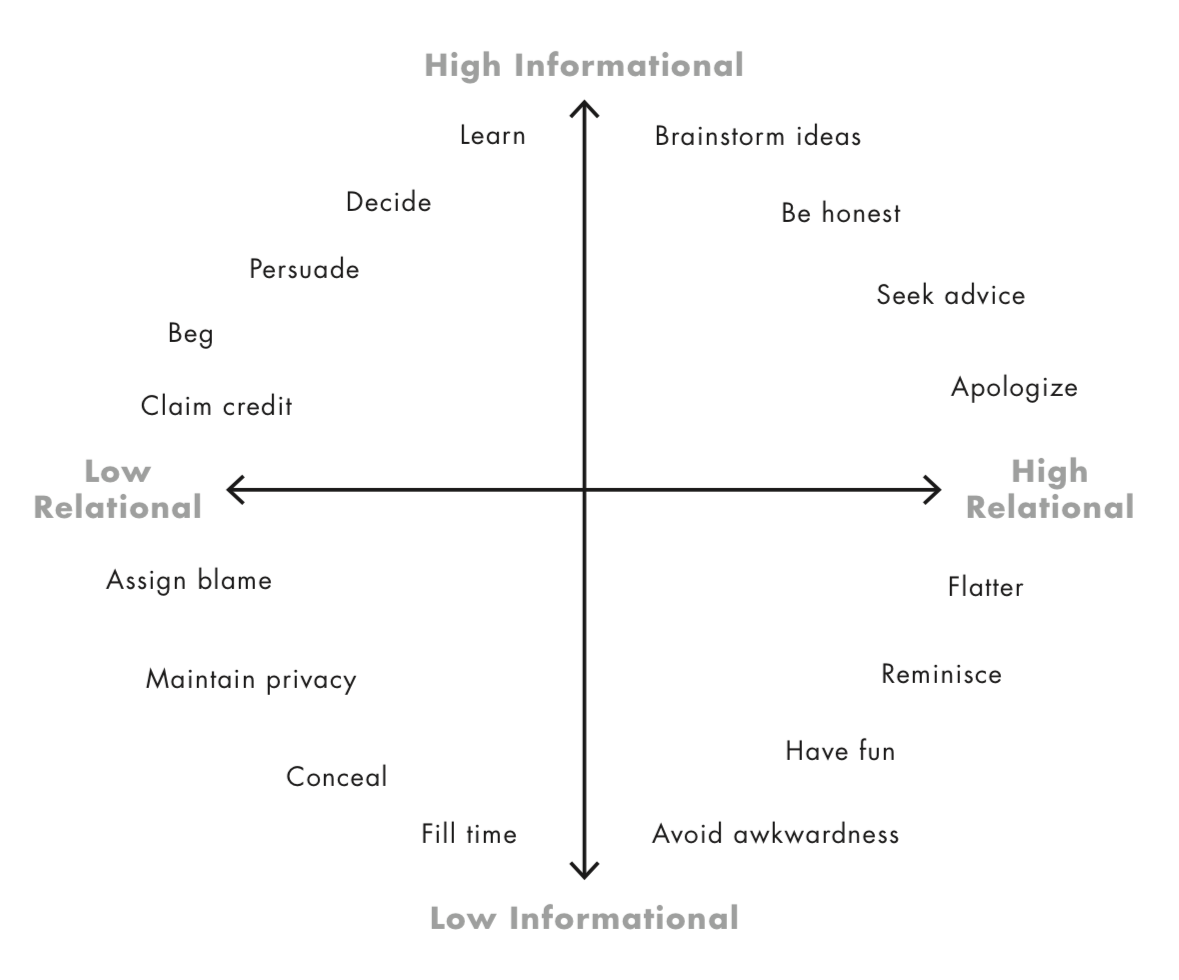
- Goal #1: understand convo partner’s purpose / motivation
- Informational axis
- Relational axis
- Purpose of convo is always shifting
- Maxims:
- Topics
- Asking
- Levity
- Kindness
2: T - Topics
- Topic: chunks of thematically related conversational turns that convey meaning across speakers
- Topic forethought before convo
- Universal topics*
- recently?
- What are you excited about recently?
- …
- When did you last cry in front of another person? To yourself?
- Convo pyramid:
- Small talk: universal
- Tailored talk: many groups could discus, but not all
- Deep talk: only this group
- Study: more frequent topic switches lead to better convos
- 3 signs it’s time to switch topics:
- Longer mutual silences
- More frequent polite laughter
- Redundancies
3: A - Asking
- Collaborate + co-create
- Must lead to disclosure
- Sensitive (vs benign) questions don’t have a downside nearly as much as we think
- 4 types of questions:
- Introductory
- Mirror: eg. “how are you?”
- Topic switching
- Followup
- Followup:
- “How’d that make you feel?”
- Positive vs negative intent
- Open-ended questions
4: L - Levity
- Feelings:
- Arousal axis: signal of energy
- Valence axis: pleasure vs displeasure
- Levity: any conversational move - playful, funny, unexpected, warm - that infuses positive energy
- Psychological safety + trust
- Triggers mutual disclosure
- Good humor is acutely context-sensitive
- Humor
- Benign violation theory of humor
- Humor that builds people up > tears down or calls out
- Self-deprecation, especially criticism form earlier in career
- Find the fun rather than trying to be the fun
- Seinfeld humor: raise voice, fake outrage, surprise, exaggeration
- Make a big point out of a small detail
- Label it a flop immediately if it doesn’t work
- “I’ll be here all night”
- Laugh
- Flattery
- You can never give too many compliments
- “I admire how you X”
- “You’re a role model for X”
5: K - Kindness
- Egocentrism
- We misunderstand questions much more commonly than we think (90% → 75% → 43%)
- Respectful language: make people feel…
- Seen and known
- Good to be with
- Worthy of care
- Use their name
- Listen responsively
- Back channel: “oh yeah”, “nice” etc.
- On-topic interruptions = engaged listening
- Actively respond
6: Many minds
- Status ranking
- Surprising agreement be
- Dynamic throughout convo based on topic / context
- High-status members should…
- Stay out of the way
- Create psychological safety
- Vulnerability
- Kindness
- Large group convo:
- Partitioning
- Centralizing
- Convo steward
7: Difficult moments
- Disagreement = diff in perspective
- Depth of difficulty:
- Content
- Feelings
- Motives
- Identity
- Safe + heard to modify identity
- Receptiveness recipe
- Acknowledge
- Affirm
- Validate
- Hedge responses
- Aim to learn
- Positive framing
- Sharing personal stories
- Avoid explanation words
- Lean > persuasion
- Egocentric projection: false consensus
- Defer to explicitly getting their perspective
- Treat people and complex and nuanced, not collapsed into stereotypes
- Cognitive reappraisal: shift interpretations of bodily reaction (eg. sweaty palms) as negative → positive
- Shift context (environment)
- ↑ reframing helps when emotions get hot
8: Apologies
- Apology: 1) understand, 2) take responsibility
- Apolgoize frequently and sincerely
- More likely to get sued by refusing to take responsibility upfront
- Focus on the experience of recipient, not on your own rationale
- Don’t ask for forgiveness (self serving)
- Study: concrete promise to change is most strongly correlated with parole
- Study: plan to change > apology
- Feedback:
- Start positive: “I want you to thrive”, “I care a lot about our relationship”
- 5:1 positive:negative feedback ratio
Epilogue
- 3 components of happiness:
- Hedonic happiness
- Meaning
- Psychological richness
- Reflect*
- Components of identity: visible or invisible*