Noise
Daniel Kahneman2021
- Length
- 13h 28m~480 pages
- Read
- Jul 31st - Aug 13th '21
Summary
Among the two kinds of error - bias and noise - the latter is frequently overlooked as a source of high social and financial cost. For example a study conducted by an insurance firm showed a 55% median difference between underwriters, resulting in an estimated $100m+ yearly lost to noise-related inefficiency. Know the 3 types of system noise. Finally, Kahneman lays out 6 principles to overcome noise.
Key Takeaways
- Don’t overlook the costs of system noise: unwanted variability in judgements that should ideally be identical
- Know level noise (between-person) vs pattern noise (within-person, occasion noise)
- Know the 6 principles to overcome bias
Notes
6 Principles to Overcome Noise
- Accept that decisions are about accuracy, not individual expression
- Think statistically, and take an outside view of the problem
- Structure judgement into independent tasks (avoid excessive coherence)
- Resist premature intuitions
- Leverage the wisdom of of crowds effect (independent judgements)
- Favor relative judgements (tend to be less noisy)
Part 1: Finding Noise
- Two kinds of error:
- Bias: Systematic deviation
- Noise: Random scatter
- Can recognize and measure noise without knowledge of target or bias
- System noise: Unwanted variability in judgements that should ideally be identical
- Noise audit: Controlled test of system noise
- Median difference between insurance underwriters: 55% → est. $100M+ lost
- Other examples: judicial system, financial investors, patent applications
- Singular decision: (vs recurrent) can’t measure noise, but must recognize it’s still there (eg. Obama’s Zika response)
Part 2: Your Mind is a Measuring Instrument
- Within-person reliability: Single person, multiple trials
- Between-person reliability: Multiple people, same trial
- Many predictions are non-verifiable, eg. probabilistic, theoretical, long time horizon
- Due to unreliability, focus on process rather than result of prediction
- Evaluative judgements: (vs predictive) judgement by evaluating situation / choices
- Decisions involve predictive + evaluative “”
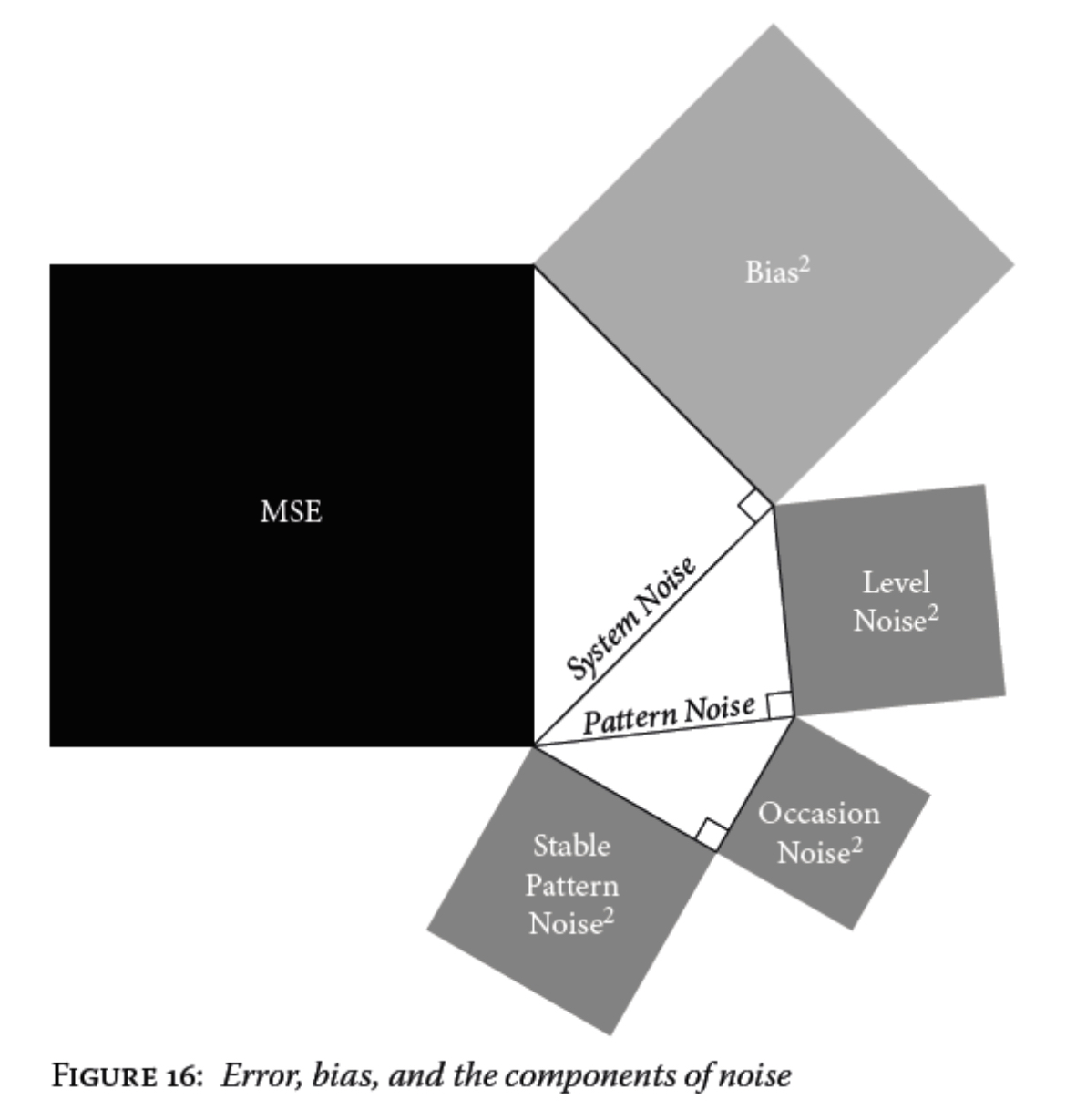
- Use MSE to determine overall error
- Sum of squares of bias and noise
- Level noise: (between-person) disposition causing bias from average judge
- Pattern noise: Patterns of within-person noise / bias based on traits upon evaluation
- Predisposition for trait, eg. racist
- System noise = level noise + pattern noise
- Occasion noise: Within-person noise related to context + intrinsic variability
- Component of pattern noise
- Internal probability distribution
- Mood, stress, weather, sequence etc.
- Wisdom of crowds effect: averaging multiple predictions generally superior
- Gambler’s fallacy: Tend to underestimate the probably that streaks occur by chance
- Social influence creates significant noise across groups
- 1 upvote: 32% more likely than no upvote
- Internal discussion often creates greater confidence, unity, extremism → more noise
Part 3: Noise in Predictive Judgements
- Models outperform human judgement
- Simple models can be better, ignoring noise
- Broken leg exception: Decisive information for when to override model’s prediction
- AI/ML excels in unbiased pattern detection
- People are notoriously overconfident in forecasting abilities
- Objective ignorance: many phenomena are hard to predict at all, but we ignore
- Social sciences avg correlation coefficient r = 0.2, 3% r >= 0.5, highly unpredictable
- Causal thinking: when end is known, easy to see likely path - despite many forks in road leading to vastly overestimated probability
- Valley of the normal: Appear normal in hindsight but not expected / predictable
- Causal vs statistical thinking
Part 4: How Noise Happens
- Psychological biases can create system noise or bias depending on nature
- Bias with unknown result: factor that shouldn’t affect judgement does, vice versa
- Excessive coherence / halo affect: tend to jump to conclusions, stick to them (ordering matters)
- Matching: Matching value to another on some other scale (eg. mood → rating)
- Matching predictions: often fail to consider strength of correlation (regression to mean)
- Comparative / relative judgements are more accurate than categorical / absolute
- More sensitive to relative values than absolute values (eg. item cost)
- Scale ambiguity: Choice of scale can make large difference in noise of judgements
- Pattern noise: can be result of differences in knowledge, information
- Big 5 model of personality: extroversion, agreeableness, conscientiousness, openness, neuroticism (OCEAN)
- Behavior = personality + situation (context)
- Pattern noise > level noise
- Outside view: Properly factoring in averages (similar cases), ignoring the particulars of the case
- Stable pattern noise: per-person bias for given case based on traits, largest component
- Easier to fix level noise, pattern noise often overlooked (eg. grading on a curve)
- Fundamental attribution error: Tend to assign blame / credit to agent that’s better explained by luck, objective circumstances
Part 5: Improving Judgements
- Criteria for a good judge: well trained, more intelligent, right cognitive style
- Respect expert: thought leader whose judgements cannot be objectively evaluated, only compared to other experts
- Eg. politics, philosophy
- Vs knowledge expert
- ^ how: years of experience, confidence + coherence, intelligence, grit
- Active open-minded thinking: actively search for contradicting personal opinions
- “When the facts change I change my mind”
- Decision hygiene: rules and steps that prevent bias and noise before they occur
- Base rate: Baseline probabilities of event before personal judgement introduced
- Diverse, independent group → better crowd wisdom, group judgement outcomes
- Guidelines / frameworks reduce noise
- Concreteness of rating scales v. important
- Evaluating companies: rate each part completely independently, individual ratings before discussion, view ratings at end and come to judgement organically
Part 6: Optimal Noise
- 7 objections to reduce or eliminate noise:
- Expensive
- Efforts might Introduce new errors
- Respect + dignity
- Essential for evolution of new values
- Gaming the system
- Noise → risk averse → deterrent
- Don’t want to be cogs in machine
- Watch out for noiseless but biased algos
- Rules vs standards: eg. no profanity (well-defined) vs no bullying (interpretable)
- Noise neglected by professionals who don’t see it as relevant to them