Incorruptible
Eric Ries2026
- Length
- 12h 5m~399 pages
- Read
- Jun 27th - Jul 13th '26
Summary
Ries argues that mission drift, bureaucracy, and financial gravity are structural outcomes of modern corporate governance. Markets select for value capture as readily as value creation, while shareholder primacy pushes companies toward short-term extraction. Durable institutions need a purpose aligned with human flourishing, an ethos that survives the founder, and governance that protects mission from investors, executives, and the organization’s own emergent incentives.
Ries’s blueprint moves from company design to ecosystem design: align the business model with the mission, track wholistic metrics, build constitutional governance, and use structures such as PBCs, long-term voting, steward ownership, constellations, and spiritual holding companies. Mission then extends through standards, transactions, and civic infrastructure, turning trust and beneficial constraints into long-term competitive advantage.
“Most fears about AI are best understood as fears about capitalism.“
“The market has been optimized for those who trade fastest in the smallest increments - not for the companies building long-term value or the investors trying to own them.”
“When you grow up, you tend to get told the world is how it is. Life can be much broader when you discover one simple fact, and that is that everything around you that you call life was made up by people that were no smarter than you. And you can change it. Once you learn that, you’ll never be the same again.” ~ Steve Jobs
Chappy’s Review
Love where Ries is coming from with this book. Aligned with my own thinking on how we must evolve shareholder capitalism and our economic systems in general. Wish it returned to a little more of the philosophical stuff towards the end.
Key Takeaways
- Markets do not reliably select for value creation; the more golden the goose, the stronger the temptation to destroy it.
- Good corporate architecture needs institutionalized succession, mechanisms for profit vs mission tension, and a constitutional foundation against short-term extraction.
- Capitalist transactions work only when voluntary and informed.
- Capitalism succeeds despite profit maximization and corruption.
- Financial gravity changes behavior and eventually values, even when no one explicitly orders it.
- Gravity overrides direct authority, works through perception, and grows with size and balance.
- The nested doll effect makes each level feel the weight of the resources above it.
- When a company goes public, everyone starts watching the stock ticker.
- Governance must protect purpose, coherence, and integrity alongside compliance.
- A founding charter should define a specific beneficial purpose aligned with human flourishing.
- Shareholder primacy turns a single metric into short-term thinking and underweights the trust of employees, customers, and communities.
- Builders act like they run the show, but the governance class has the final say.
- Profit is the maximization of human flourishing: align the business model so more money requires accomplishing more mission.
- Harder is easier: mission aligned with the business model, principled decision making, and a commitment to figure it out.
- Mutual success creates win-wins and lets the company become the table on which the pie sits.
- Extractive companies carry structural weaknesses, deferred liabilities, and negative externalities that surface over time.
- Mission survives financial gravity when it becomes an institutional commitment.
- False proxies create misleading progress, such as call-center wait time or lines of code.
- Wholistic metrics track value creation, verify fiduciary promises, and preserve natural tension between competing goals.
- The invisible leader is the common purpose that guides action when no manager is present.
- The alignment method combines the culture bank, leaders guide, and two-way review.
- Founder-controlled companies should evolve into mission-controlled institutions.
- Public Benefit Corporations let directors balance shareholder benefit with a stated public benefit.
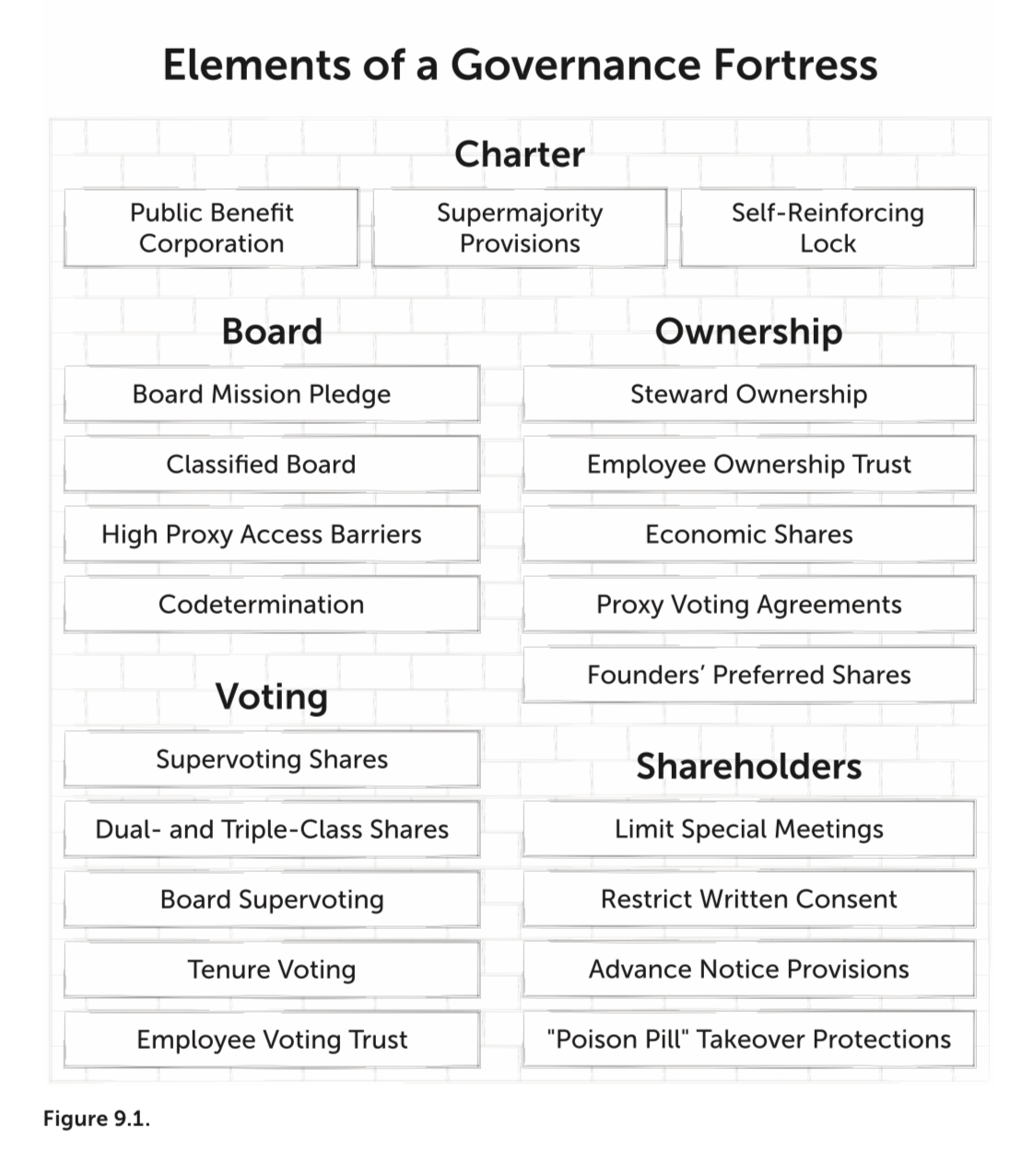
- Mission protection can use long-term voting, economic shares, co-determination, steward ownership, and mission guardians.
- Effective pledges are specific, actively recited, tied to decisions, freely chosen, and social.
- Treat investors as partners; mission protection creates a trustworthy counterparty and defensible moat.
- Mission lock comes from constellations of independent, economically interdependent entities orbiting a common purpose.
- Three elements: multiple legal entities, economic interdependence, and common purpose.
- Beneficial constraints limit certain freedoms while creating greater value for all participants.
- Entity types include operating companies, twin-sister nonprofits, truth guardians, network infrastructure, and specialized vehicles.
- Spiritual holding companies protect mission by separating governance authority from ordinary ownership.
- A spiritual holding company governs one or more companies to protect and advance their purpose over the long term.
- Economic foundations and non-economic LTBTs offer two major models.
- Perpetual purpose trusts exist indefinitely for a stated purpose rather than for beneficiaries.
- Mission transmission extends values through every transaction, relationship, standard, and spillover effect.
- Five multipliers: consider mission in every transaction; use it as a tiebreaker; clear the path for allies; signal with costly commitment; create recourse.
- Strong standards combine crystal clarity, independent verification, and aligned consequences.
- Make compliance the most lucrative path; code first, then standardize.
- Civic infrastructure uses beneficial constraints and trust to solve collective-action problems.
- Three attributes: rule-setting or coordinating power, tiny relative to what it governs, and trust as essential currency.
- Standards can grow an industry by creating shared trust and connection.
- You can make something impossible feel inevitable by building the institution that coordinates it.
- You have gravity: where you work, buy, invest, and participate helps shape the system.
- Small changes accumulate into the markets and civic infrastructure we inhabit.
- A maximum ethical salary or personal margin cap can constrain extraction at the individual level.
Notes
Introduction
- LTSE: long-term stock exchange
- Mission drift, bureaucracy → corruption
- First: not every form of making money is equally good
- Blueprint for flourishing over the long term:
- Create something worth protecting
- Aspirational mission aligned with human flourishing
- Principled ethos that instills in everyone it touches the determination to see the mission through
- Build with structural integrity
- Grow more mindfully
- New corporate governance
- Create something worth protecting
- Mission > founder, investor control
1: The Shape of the Abyss
1: The mystery of the golden goose
- If mission-driven companies outperform profit-chasing companies, we should expect them to outcompete via Darwinian selection - but that’s not what we see
- Though, market does not select for value creation
- Treating employees, customers, community well → destroyed by investors
- The more golden the goose, the stronger the temptation to destroy it
- Capitalist transactions only work when voluntary and informed
- Capitalism succeeds not because of profit max / corruption, but despite it
- Need good corporate architecture:
- Institutionalized succession to bear multiple generations
- Mechanisms to survive the tension between profit and mission
- Constitutional foundation to resist short-term extractive thinking which dominates modern best practice
2: Who is the bank?
- Emergent intelligence: doesn’t exist in any single entity (eg. colonies, neurons)
- If the person at the top is not in charge than who is? Accountability unclear
- Eg. CEO, board, shareholders
- “The bank” is an emergent intelligence
- No individual can ever be held responsible for the superorganism
- This is the reason for decline in trust
- Founder mode: re-exerting control over org when it’s drifting from ethos
- Ted Chang: “most fears about AI are best understood as fears about capitalism“
3: Gravity
- “Big co disease”: bureaucracy, short-term thinking, hollow culture
- Outside experts homogenize
- Financial gravity: the psychological pressure that behavior and eventually values
- When a company goes public, everyone starts watching the stock ticker
- Gravity overrides direct authority
- Must match competitors
- Gravity works through perception
- Gravity is a function of size and balance
- Nested doll effect - each level feels the weight of the resources above it
- Whole Foods financial gravity story*
- Solution: governance
4: The New Governance
- Fiduciary duty requires you to sell to the highest bidder at all times
- Founding charter defines purpose
- Most modern neutral charters simply allow any business - commonly interpreted to max shareholder returns
- ↑ 3 legged stool of OG incorporation:
- Only for a specific beneficial purpose
- Board duty to pursue chartered mission without self-dealing
- Duty to stockholders not to misappropriate funds
- General incorporation is recent (late 1800s) - kicking stool 1
- Lawful determined by two common law traditions:
- Trust law: trustees managing property for beneficiaries
- Agency law: agents acting on behalf of principals
- Shareholder primacy: ↑
- Arguments to max shareholder value:
- Moral - without $, wouldn’t exist in the first place
- But, $ capital generally less than human capital etc. invested
- Shareholders are residual claimants (passive recipients at the end)
- Though, easier for shareholders to exit than employees or customers
- Shareholders face unique agency problems - info asymmetry, must trust not to exploit
- Most legitimate
- Though, employees customers etc. must also trust company
- Securities laws, auditing etc. covers this, protects investors
- A single metric makes business straightforward, creates clear accountability
- Leads to short-term thinking
- Moral - without $, wouldn’t exist in the first place
- “Builders act like they run the show, but… it’s really the governance class who have the final say”
- Real governance requires 4 responsibilities:
- Compliance: oversight + control
- Purpose: mission aligned with human flourishing
- Coherence: singular, unified direction
- Integrity: protected from external forces (BoD especially)
- Gravity: both most apparent force and weakest force
2: Escape Velocity
5: The Blueprint
- Create something worth protecting
- Build with structural integrity
-
- compliance, purpose, coherence, integrity
- Align the business model with the mission
- Eg. Love as decision-making guide (what would you do if the customer were your parent?)
- Deferred liabilities are slimy profits
- Eg. pollution you’ll have to clean up
- Negative externalities
- Eg. hitmen for hire company
- Does it count as legal + profitable if they lobby gov’t to legalize?
- Lesson: companies that extract rather than create value have structural weaknesses that lead to real problems in the long run
- Idealism → a builder’s intuition
- Builders should embrace “profit is the maximization of human flourishing”
- Companies that invest in mutual success create win-wins, “become the table on which the pie sits”
- Resolves 3 conceptual challenges plaguing business for generations:
- Double/triple bottom line (eg. profit + purpose) → human flourishing
- Upends for-profit vs non-profit distinction
- Dissolves capitalism’s most frequent critique: profit > people
- Money will follow the mission
6: Harder Is Easier
- Costco hot dog values
- Harder is easier mission:
- Mission aligned with business model so the company only makes more money by accomplishing more mission
- An ethos that includes a commitment to principled decision making
- A commitment to figure it out when challenges arise
- Profit-maximizing businesses create a cutthroat culture that kill it in the long run
- Meaning + purpose is top driver of employee talent
- Enshitification risk: ↑ attracts talent and customers but also those who’ll try and extract it from you
7: Mission Drive
- Mission-driven needs to be woven into the company’s fabric to withstand financial gravity
- Patagonia
Let My People Go Surfing
- Must evolve into institutional commitments
- J&J story + profit pressure*
- False proxies: misleading progress, eg. call center wait time or lines of code
- Wholistic metrics:
- Value creation: track all value created, not just value captured
- Fiduciary verification: for each fiduciary commitment, maintain metrics that track that promise
- Natural tension: build in metrics that fight each other (eg. customer satisfaction + profit)
8: The Invisible Leader
- Incoherence: where what gets rewarded contradicts what gets proclaimed
- The invisible leader: “the common purpose that guides actions even when no manager is present”
- The alignment method:
- The culture bank: a tool to make visible the invisible elements of culture building (brand bank ++)
- The leaders guide: a living doc of real stories of leading with ethos
- Action, ethos tie, reward
- The two-way review: aggregated stories during review period represent judgement of company + its culture
- OKRs antagonistically judge by who withdraws from the culture bank account most
- Set a no (international) withdrawals policy
- Lore is humanity’s oldest tool for transmitting knowledge
- The department of corporate purpose:
- Consolidates what’s scattered across marketing, product, HR, investor relations, customer support
- handbook.gitlab.com: whole company is public - no tacit knowledge
9: Constitutional Governance
- Protections often loo early → too late
- Public Benefit Corporation (PBC): directors are legally allowed to balance shareholder benefit with the company’s stated public benefit
- Enhanced business judgement rule: ↑ wide discretion in making decisions
- Rational + informed
- Wide but specific aspect of human flourishing
- All leading AI labs agree that “standard shareholder primacy governance would be catastrophic for stewarding this transformative technology”
- Lots of solutions for “mission guardians”
- False argument that founder-controlled companies are irrational → routinely outperform due to long-term orientation
- Super-voting shares: ↑
- Still owe fiduciary duty
- But exacts a psychological toll
- Should be a temporary bridge
- Founder-controlled → mission-controlled
- Every BoD director should be required to take a mission-driven pledge
- ↑ also governing-class-wide, eg. Hippocratic Oath → Director’s Oath
- 5 traits of effective pledges:
- Specific
- Actively recited
- Tied to decision points
- Freely chosen (can decline, but matter of public record)
- Social (everyone knows it’s mutual as precondition of service)
- Long-term voting: voting grows from 1 → 10 votes over 10 years
- Economic shares: non-voting
- eg. class C
- Co-determination: prioritize employees
- Steward ownership: ↑ employees or even customers own
- Dealing with lawyers:
- What to do → pros + cons (within legal bounds)
- If cons win, demand alternatives
- Remember, they’re revealing their priorities
- Talking to investors:
- Treat as partners, not superiors
- Responses
- “It’s always too early until it’s too late”
- “They might feel the opposite when they see our results” - can always change later
- Examples of successful non-traditional gov companies
- “Complex structures that protect the mission actually make us attractive to long-term investors. They want companies with defensible moats. Mission protection is exactly that kind of moat.”
- “If they’re redundant, what’s the problem with having the belt and suspenders just in case?”
- “I need to promise to my customers that I’ll be able to make that transition when the time comes unencumbered”
- “Mission multiplies operational excellence”
- “We attract missionaries vs mercenaries”
- “Help me understand [your LPs] specific concerns. I’m happy to join your partners meeting to explain why this makes us a stronger investment”
- “Know that they make sense to me as the best way to build a competitive advantage by becoming a trustworthy counterparty”
- Magic sentence: “as the leader, it is my judgement that it is essential to our business strategy to be a trustworthy counterparty, and so we need to implement X provision in order to make promises they can believe”
- No harm in trying
10: The Constellation View
- Constellations: multiple entities that orbit around a common purpose so tightly that they appear to be a single organization
- Each maintains independence while exerting gravity on each other
- Common good comes before the individual good
- Beneficial constraints: structures that limit certain freedoms but ultimately create greater value for all participants
- 3 elements of mission lock:
- Multiple legal entities
- Interdependence (economic)
- Common purpose
- Paradox:
- If vertical integration is so powerful, why doesn’t one mega-corp eventually own everything?
- If decentralization works so well, why have firms at all? Why not just contracts all the way down?
- Transaction costs: ↑ searching, bargaining, and enforcing contracts
- Firms internalize when “” too costly, expand only until internal bureaucratic costs outweigh those savings
- Thus, firms should weigh control and efficiency
- ↑ for missions, create entities when doing so expands the ability to pursue the shared mission and earn the trust needed to sustain it
- Types of entities:
- Operating companies
- Twin sister: non-profit that makes charitable grants serving a strategic purpose
- Truth guardians: research entities free from earnings calls
- Network infrastructure: creates shared systems, eg. co-op
- Specialized vehicles: eg. local regulation, industries
- Economic co-ownership
- Modern problems:
- Succession of founders
- IPOs less desirable, 4 → 11y
- PE struggling to sell
- 76% of founders regret selling their co within 1y
11: The Spiritual Holding Company
- Spiritual Holding Company (SHC): a separate entity with governance authority over 1+ companies design to protect + advance authority over the long term
- Eg. Anthropic’s golden shares: voting without ownership
- Two major types of SHCs ↓
- Economic foundation:
- Non-economic LTBT:
- Perpetual Purpose Trust (PPT): indefinitely for a stated purpose rather than for beneficiaries
- ↑ these techniques are deeply buried
3: To Bend the Light
12: Mission Transmission
- Can also exert external gravity to own mission
- Mission transmission: the systematic process of ensuring that every transaction and relationship extends the org’s values beyond its own walls
- 5 transmission multipliers:
- Consider mission in every transaction
- Make mission a tiebreaker
- Clear the path for allies
- Signal with costly commitment
- Create mechanisms for recourse
- Spillover effects: systematic changes in local communities that result from org choices
13: The Power of Standards
- Standards often grow the entire industry
- 3 components of a standard:
- Crystal clarity
- Independent verification
- Aligned consequences
- Standards allow orgs to architect and profit from an entire ecosystem
- Eg. shipping containers 50x’d efficiency, 97% drop in cost
- Should make compliance the most lucrative path
- Eg. B Corp certification
- Code first, then standardize
- Eg. Internet, Linux, Git
14: A New Civic Infrastructure
- Steve Jobs: “When you grow up, you tend to get told the world is how it is. Life can be much broader when you discover one simple fact, and that is that everything around you that you call life was made up by people that were no smarter than you. And you can change it. Once you learn that, you’ll never be the same again.”
- Skeptics said we couldn’t create…
- Libraries, Wikipedia, credit unions, national parks, the internet
- Civic infrastructure: “organizations that facilitate the flourishing of other institutions and communities by creating beneficial constraints, shared trust and connection, and solving collective action problems that enable public goods”
- Avg holding period of stocks 8y in 1960 → 4m today
- “The market has been optimized for those who trade fastest in the smallest increments - not for the companies building long-term value or the investors trying to own them”
- 3 shared attributes:
- Posses rule-sharing or coordinating power
- Tiny relative to what they govern
- Trust is their essential currency
- “… you can make something impossible feel inevitable”
- LTSE*
15: You Are Traffic
- We’re all drawn to helping our + others flourishing
- In modern surveillance capitalism, organizations are obsessed with you
- Willingness to pay
- ↑ unless monopoly / lock-in
- You have gravity - make the small changes
- Maximum ethical salary / personal margin cap