Enlightenment Now
Steven Pinker2018
- Length
- 19h 49m~576 pages
- Read
- Mar 19th - 24th '23
Summary
The Enlightenment ideals of reason, science, humanism, and progress have delivered extraordinary gains across every measurable dimension of human welfare. The availability heuristic and negativity bias make us systematically pessimistic about the world even as we're optimistic about ourselves. Eco-modernism and dematerialization are decoupling productivity from resource use. Democracy, equal rights, and liberal values continue their uneven but undeniable advance. The threats are real but they are problems to solve, not signs of civilizational decline.
Key Takeaways
- Unfairness, poverty > inequality
Notes
1: Enlightenment
1: Dare to understand
- Enlightenment: dare to understand
- Freedom of thought and speech
- Optimism: all failures are due to insufficient knowledge
- Reason, science, humanism, progress
- Humanism: individual > group
- Specialization and altruism
2: Entropy, Evolution, Information
- Entropy: nature resists entropy
- Evolution: entropy in replication
- Information: ordered, useful patterns
- Knowledge: accurate info about world
- Agriculture → free time for all else
- Need to overcome adaptations malformed for modern day
3: Counter-enlightenments
- Political views → secular religions
- Backlash against science
2: Progress
4: Progresso-phobia
- Optimism gap: generally optimistic about self but pessimistic about world
- Availability heuristic: daily news focuses on the bad → world is getting worse
- “Bad is stronger than good”
- Loss aversion, bias towards worst cases
- News sentiment quantifiable more negative
- “50 reasons we’re living through the greatest period in human history”
5: Life
- Life expectancy
- 1990 → 2010: +4.7 years (3.8 healthy)
- Infant, maternal mortality rates
- Bearish on immortality, Kurzweil’s take
6: Health
- Infectious disease and germ theory
- Eradication of infectious disease
7: Sustenance
- Famine, stunting, undernourishment
- Population bomb fallacy
- Industrial farming, fertilizer, GMOs
8: Wealth
- GWP: Inflation, PPP adjusted but not adjusted for new and better tech
- Consumer surplus
- Science, institutions, change in values
- Ending extreme poverty by 2030
- Market > communist economics
- Free trade (comparative advantage)
- Science and technology
9: Inequality
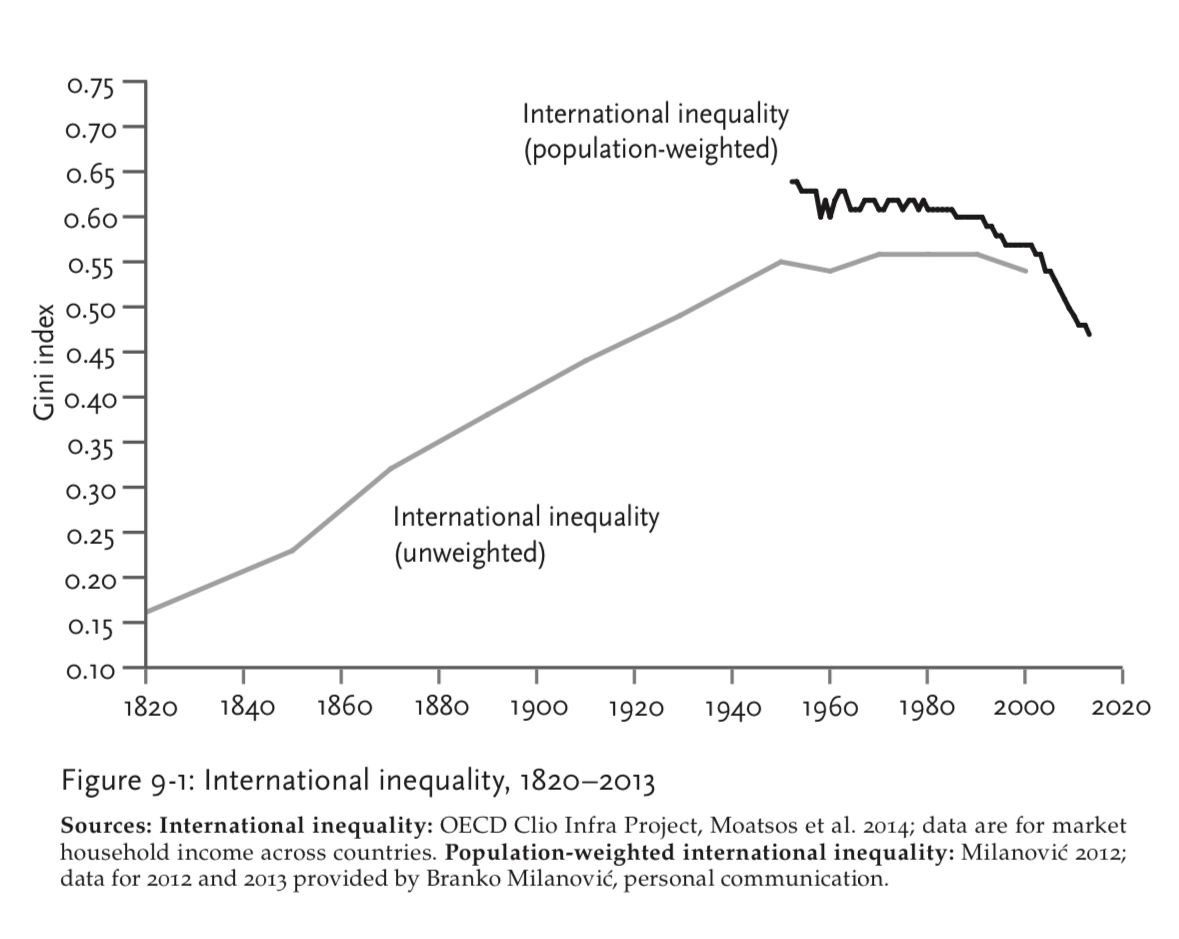
- Inequality is legitimate and increasing
- Inequality is not fundamental to wellbeing
- Equality not correlated with happiness
- Meritocracy, fairness is far more important
- Gini index shouldn’t be a bellwether
- Kuznets curve: inverted U of inequality for developing nations, wealth
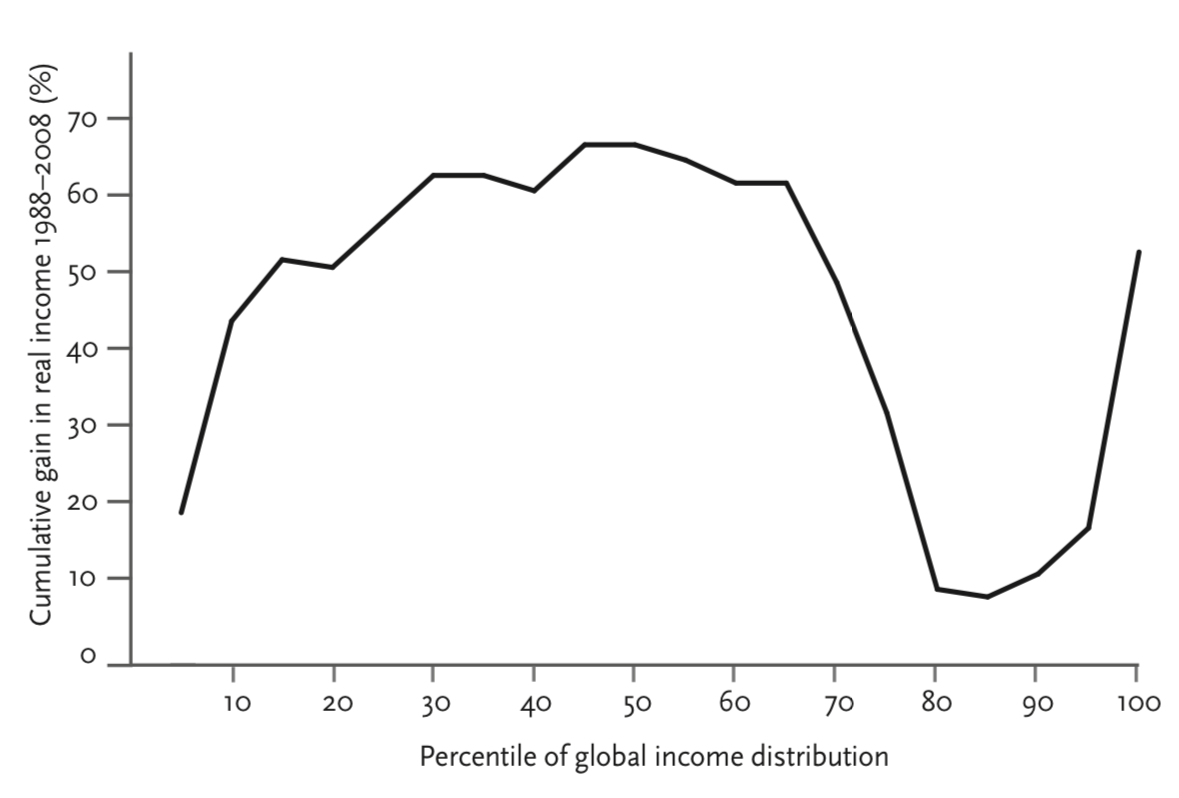
- Globalization helped lower and middle classes of poor countries and upper class of rich countries
- Consumption > income
- UBI, negative income tax
10: The environment
- Ecomodernism: replacing existing nature with more eco friendly alternatives
- Kuznets curve: of caring about environment
- Resource scarcity is not a concern
- Environment as problem to solve, not fundamental shortcoming of capitalism and industrialization
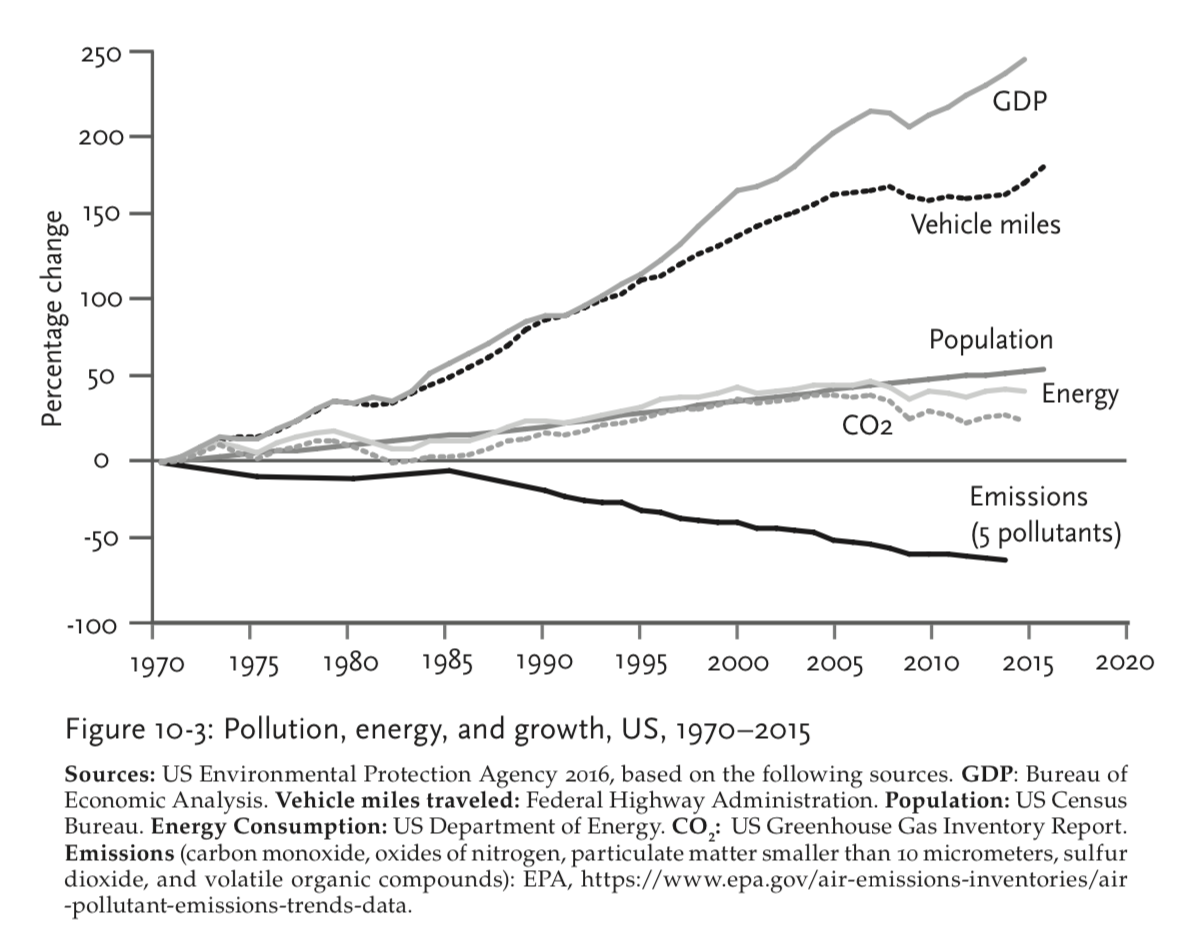
- Dematerialization: decouple productivity from resource use
- Per capita resource consumption is cresting
- Carbon emissions not linked with growth
- We are making progress
11: Peace
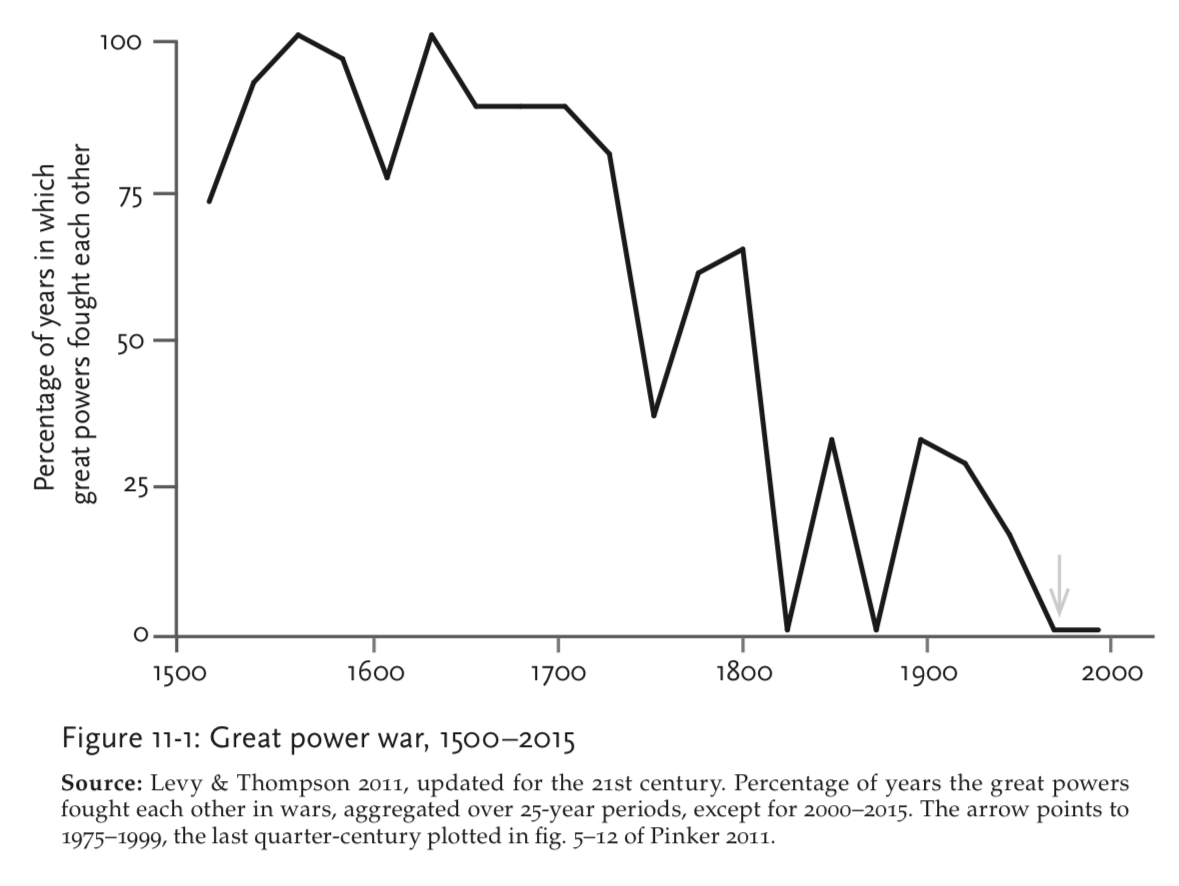
- Less war than ever
- War is illegal, more costly (global trade)
12: Safety
- Homicide became taboo in 14th century
- Progress is not strictly up, eg. 1960s boom in violence, crime erased 100y of progress
- Root cause-ism: pessimistic belief that deep human morals prevent social progress
- Enforcement: effective, legitimate, fair, moderate, humane
- World is much safer in basically every way
13: Terrorism
- Terrorism is a distraction
- Death by accident is 700-3000x more likely
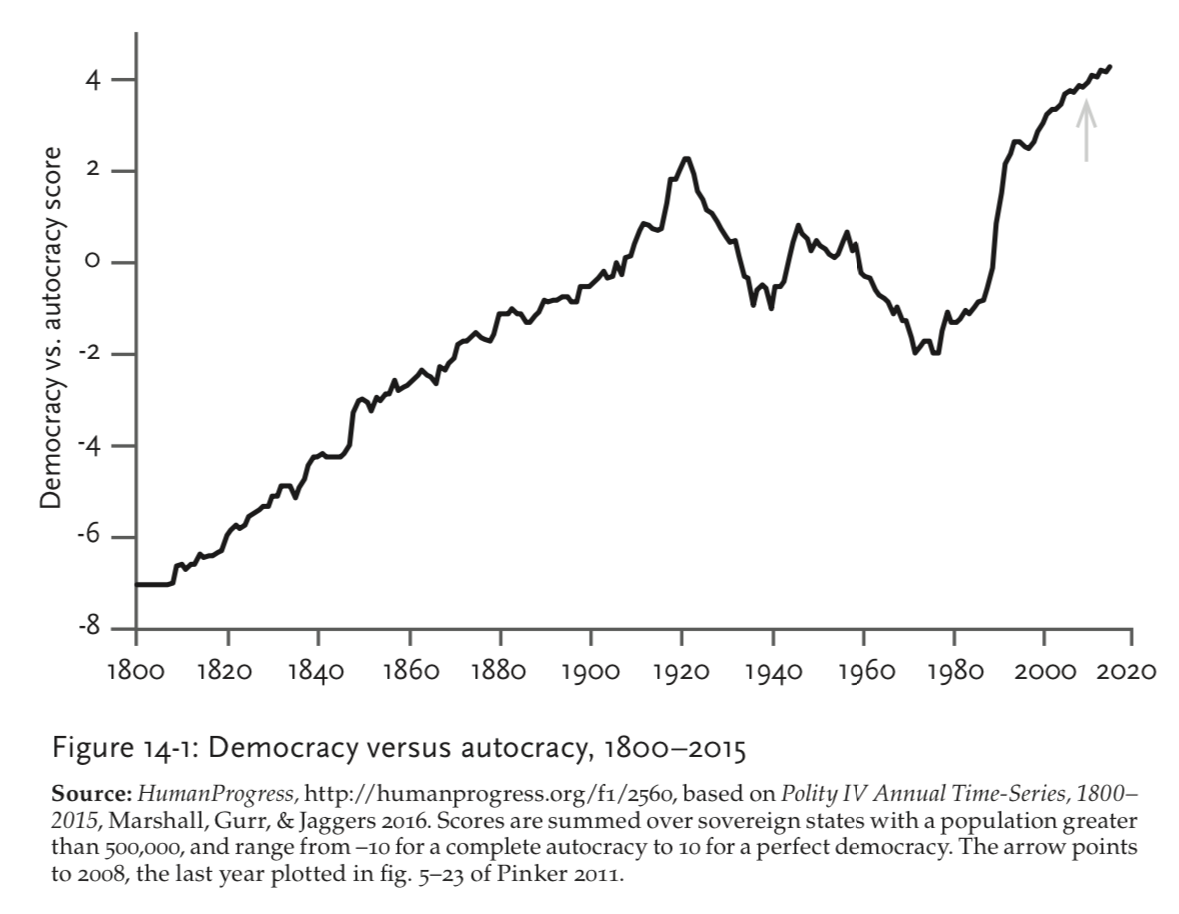
14: Democracy
- Democracy = progress
- Democracy ↔︎ autocracy is a spectrum
- Even “not free” is more free than in past
- Democracy: “giving people the freedom to complain”, peaceful transfer of power
- Moral standards rising, masking progress
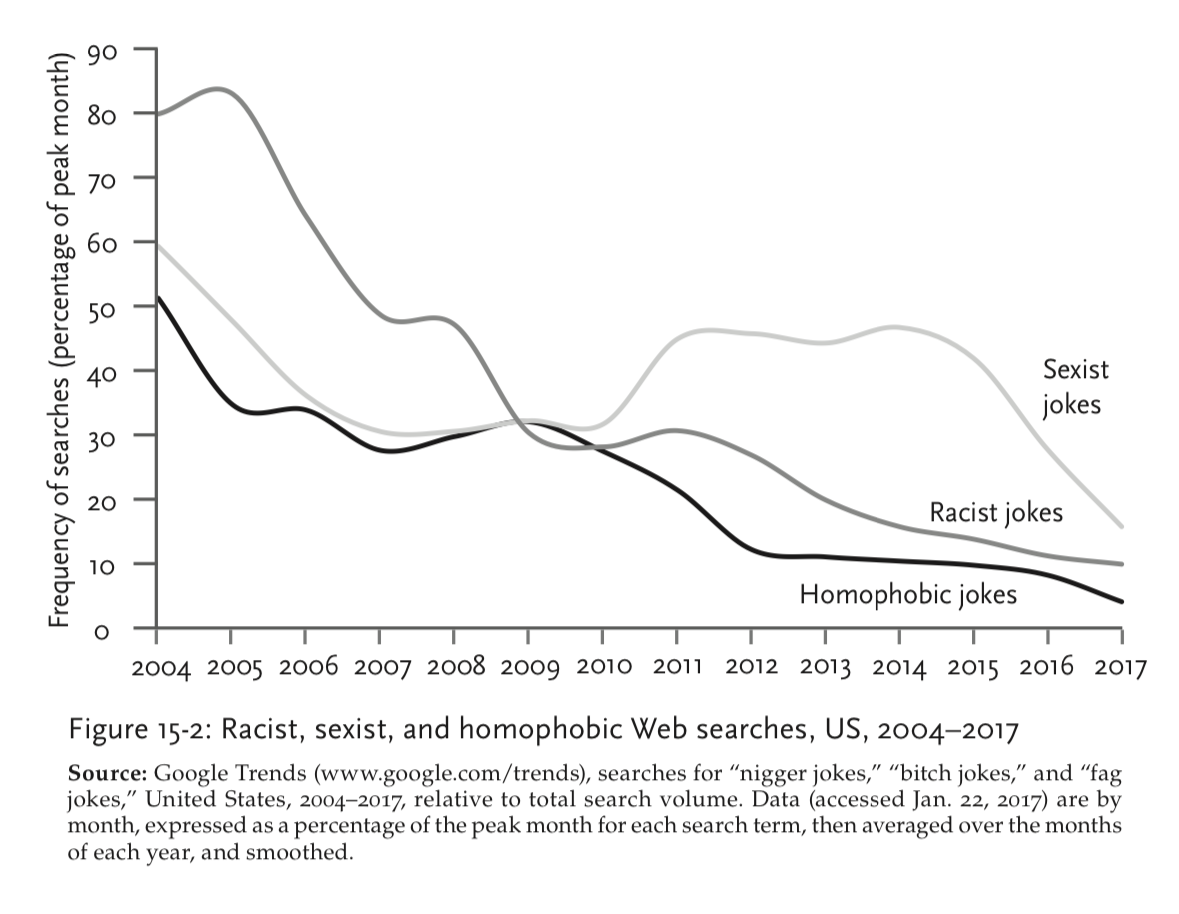
15: Equal rights
- Private racism decreasing (Google search)
- “Historical arc bending towards justice”
- Maslow’s hierarchy of needs
- Steadily more liberal values
16: Knowledge
- Education: literacy, numeracy
- IQ increasing by 3 pts, 1/5 STD per decade
- Analytic mindset
- HDI: life expectancy, GDP per capital, education (healthy, wealthy, and wise)
17: Quality of life
- QOL: freedom to spend time
- 20+ fewer hours spent working per week
- 1/4 less of life spent working since 1960
- More time spent with family
- More access to content, experience
18: Happiness
- Easterlin paradox: happiness not correlated with wealth
- Disproven: happiness increased 45/52 countries between 1981 and 2007
- Hedonic treadmill: genetically predetermined baseline happiness level
- Social comparison
- Happiness: old brain, meaning: new brain
- Contributors: social support, generosity, corruption (not necessarily causation)
- Not more lonely, just different socializing
- False suicide, depression epidemics
- Modern increase in pace of change, responsibility leads to anxiety
19: Existential threats
- Overpopulation, resource shortages, pollution, nuclear war
- Nano bots, robots, AI/AGI, bioengineering
- Solution for AGI: don’t build it
- “Technology allows us to accomplish more and more with less and less”
- 72 years of nuclear threat with no catastrophe is a good sign
20: The future of progress
- Caveats: economic stagnation,
- Low growth since ’70s (3.4% → 2% → 0.6%)
- GDP/C doesn’t apply to info age as much
- Authoritarian popularism
- Peak of political influence: 14-24 years old
3: Reason, science, and humanism
21: Reason
- Expressive rationality, identity protective cognition: “What’s rational for every individual to believe based on esteem can be irrational for the society as a whole to act upon based on reality”
- Blue lie: told for the benefit of an in group
- “So convenient a thing it is to be a rational creature since it enables us to find or make a reason for everyone one has a mind to” - Benjamin Franklin
- Higher intelligence = more bias
- Super forecasters: be uncertain, test assumptions, Bayesian updating
- Dissociate beliefs from identity
- Illusion of explanatory depth bias: Think we know how things work → strong opinion, but we don’t grasp the actual complexity
- Eg. explain how a zipper works
22: Science
- Soulless scientism is too far (need morals)
- Positive vs negative eugenics
- Morals are too high, sacrificing progress
23: Humanism
- Humanism: maximize human flourishing
- Problems with utilitarianism
- “Science doesn’t teach us how to live”
- Secularization thesis: education → secular
- Fascism: belief in natural selection of groups (vs selection of genes)