Complexity
Melanie Mitchell2009
- Length
- 11h 24m~288 pages
- Read
- Nov 25th - Dec 2nd '25
Summary
Complex systems are large non-centralized networks where simple rules produce complex collective behavior, signaling + information processing, adaptation, and emergent, self-organized behavior. Across ant colonies, markets, brains, living systems, and the World Wide Web, the common pattern is collective actions over centralized control: fine-grained components explore in parallel, communicate via sampling, rely on randomness, and balance explore → exploit.
Dynamics, evolution, computation, network science, and scaling offer overlapping ways to explain complexity, but no single measure wins: algorithmic information, effective complexity, logical depth, thermodynamic depth, model complexity, fractal dimension, and hierarchy each capture something different. Idea models can reveal general concepts without prediction, while complexity science still risks intriguing analogies without a coherent mathematical theory that explains + predicts behavior.
“The cascade of detail”
“One doesn’t discover new lands without consenting to lose sight of the shore”
Key Takeaways
Notes
1: What is complexity?
- Super-organisms (ant colonies), markets, consciousness
- Efficient markets
- World Wide Web
- Common properties:
- Complex collective behavior
- Signaling + info processing
- Adaptive
- Complex system: large non-centralized network, simple rules governing rise to ↑ (3 points above)
- Emergent, self-organized behavior
2: Dynamics, chaos, and prediction
- Dynamic systems
- Eg. solar system, heart beats, brain, stock market, climate, etc.
- Laws of physics
- Non-linear systems → greater than the sum of the parts
- Logistic maps prove apparent randomness can arise from very simple deterministic systems
- ↑ randomness cannot be predicted in advance
3: Information
- Energy, work, entropy
- Maxwell’s demon (
 The Information)
 - Entropy + information
- Reversible computing
- Statistical mechanics: micro + macro states
4: Computation
- Information is processed via computation
- Incompleteness theorem
- Turing machine
5: Evolution
- Darwin’s “greatest idea in history”
- Evolution as adaptive
- Trait inheritance
- Small, discrete steps (unifying ↑↑)
- The modern synthesis: unifying evolution, inheritance, and population dynamics
- Natural selection isn’t necessarily progress
- Recent challenges toward gradual change via natural selection as the only evolutionarily force
6: Genetics, simplified
- DNA
- Cell replication
7: Defining and measuring complexity
- Multiple sciences of complexity (though quite common in science)
- DNA 2% coding regions
- DNA length is a bad measure of complexity
- Algorithmic information (compressibility)
- Effective complexity: algorithmic information content of the set of regularities
- Logical depth: contain internal evidence as having been part of a long computation or slow to simulate physical process
- Thermodynamic depth: all events leading to a particular object
- Hard to determine relative macro states leading to object
- Computational complexity: Wolfram
- Statistical complexity:
- Effective model complexity: simplest model that predicts behavior
- Fractal dimension complexity:
- Fractal: geometric shape with fine structure at every scale
- “The cascade of detail”
- Complexity as degree of hierarchy:
- Hierarchical, nearly decomposable
2: Life & evolution in computers
8: Self-reproducing computer programs
- Computer program fundamentals
- Von Neumann automata
9: Genetic algorithms
- GA algo example
3: Computation writ large
10: Cellular automata, life, & the universe
- Grid / lattice of cells responding to state of neighboring cells
- Von Neumann’s 29-cell rule → self replicating
- Conway’s game of life is a universal computer
- Wolfram’s automata
- Class 1-4
- Rule 110 as simplest universal computer
- ↑ universal computation is relatively common
- ↑ the whole universe can be explained by simple programs
- ↑ primordial cellular automata theory
11: computing with particles
- Von Neumann vs local majority vote
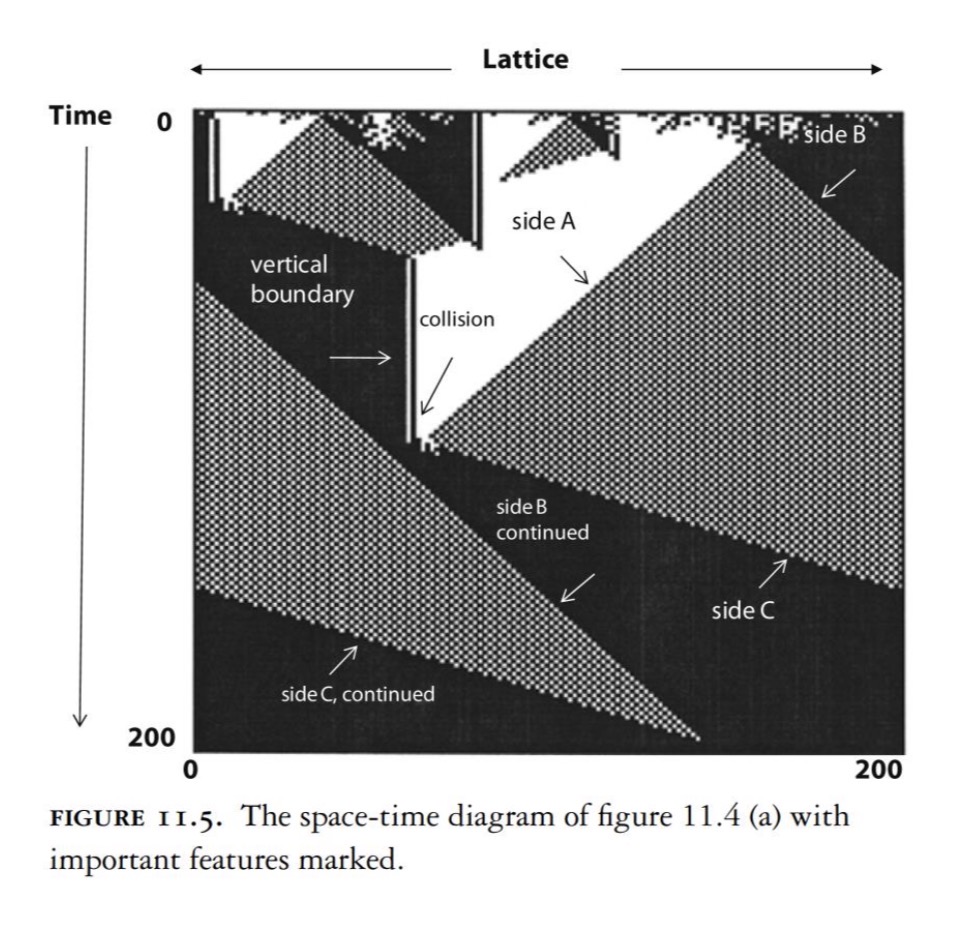
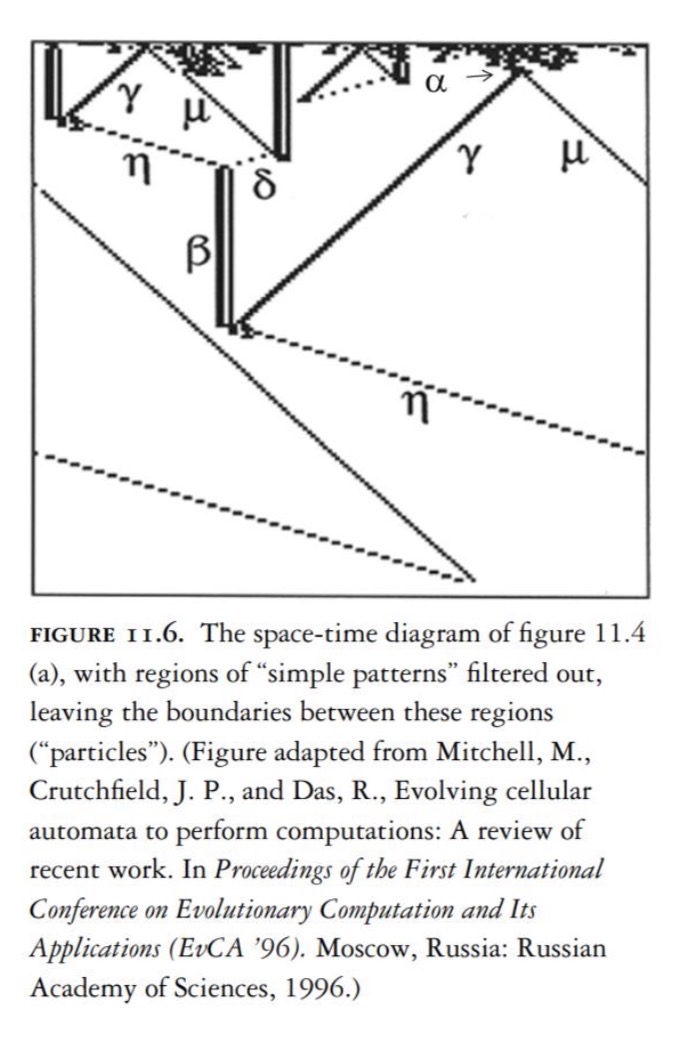
- Automata rules → “particles” of interactions that explain nature of decentralized computation
- Particle → wave-like computation for 2D → 3D objects (eg. brain)
12: info processing in living systems
- Mass, energy, information as the 3 promote components of reality
- Eg. immune system, ant colonies, cellular metabolism
- Themes of ↑:
- Focus on collective actions
- Information = statistics, dynamics of patterns over system components
- Communication via sampling
- Reliance on random components of behavior
- Fine-grained → parallel exploration, adaptability, redundancy
- Interplay of focused + unfocused processes
- Explore → exploit over time
- Meaning = fitness of system
13: Analogies in computers
- Computers have low context sensitivity
- Analogy: abstract similarity between two entities / situations
- Gödel, Escher, Bach: an Eternal Golden Braid
- Conceptual slippage enables analogy
- Explanation / prediction search strategy
- Explore exploit tradeoff
- Copycat game code-lets GA
14: Prospects of computer modeling
- Model: a simplified representation of some real phenomenon
- Idea model: simple models meant to gain insights into a general concept without the necessity of making predictions
- Eg. Maxwell’s demon, Turing machine
- Game theory
- Tragedy of the commons
- Tit for tat
- Boldness + vengefulness
15: the science of networks
- Graph theory → network science
- Network thinking: focusing on the connections > nodes themselves
- Hubs: high degree nodes
- Small world networks: few long-distance, but small avg path length; high degree of clustering
- ↑ why? Evolutionary pressure of high cost of maintaining long distance connections
- Scale free networks: scale-free / invariant distribution of node degrees
16: Real-world networks
- Brain is small world: resilience, energy efficiency, latency
- Preferential attachment: people with more connections tend to get more as well
- Tipping points ↑
- How does info spread in networks?
- Cascading failures, strategies for prevention
- Self-organized criticality:
- Highly-optimized tolerance:
17: The mystery of scaling
- Eg. BMR scales with surface area to the 3/4ths power
- Quarter power scaling laws: ↑ eg. also with fewer rate vs size
- Metabolic scaling theory: biology + physics + network structure
- Circulatory structure approximates 4th dimension
- Main critique: too many exceptions, even within species
- Zipf’s law:
18: Evolution, complexified
- Genes aren’t linear, rather…
- Genes operate in non-linear info processing networks (epigenetics)
- Evolutionary developmental biology:
- Junk DNA → gene regulation, not coding for a protein
- RBN: what determines cell type during differentiation is pattern of gene expression over time (attractor point)
- Self organization: emergence of complexity from huge networks of interconnected, mutually regulating components
- Candidate 4th law of thermodynamics: ↑ life has an innate tendency to become more complex (independent of natural selection)
- How complexity comes about through evolution is still uncertain
- 3 types of evolutionists:
- Adaptationists: natural selection is primary
- Historicists: give credit to historical accident for many changes
- Structuralists: even in absence of natural selection
- ↑ need an explanation as an integrated whole
19: Complexity sciences: past + future
- Far less developed than physics, for instance
- Cybernetics: control + communication theory in both machine and animal
- feedback, control, info, comms, purpose / teleology > mass, energy, force
- ↑ ended up being too broad and disparate to unify
- Current scientists worry complexity theory will meet the fate of cybernetics, pinpointing intriguing analogies without producing a coherent and rigorous mathematical theory that explains + predicts behavior
- “One doesn’t discover new lands without consenting to lose sight of the shore”