Capitalism and its Critics
John Cassidy2025
- Length
- 23h 19m~624 pages
- Read
- Jul 28th - Aug 24th '25
Summary
Cassidy traces the history of capitalism through its critics – from the East India Company's monopolistic abuses through Marx, Veblen, and modern critiques. Key themes: the labor theory of value, surplus extraction, the tension between productive and parasitic industries (ads, finance), and capitalism's tendency toward concentration and crisis. The book dates capitalism's birth to 1770s England and notes that socialism polls more favorably than capitalism among 18-29 year olds.
Quotes
In a capitalist system, compulsion to work is disguised by a seemingly voluntary market transaction.
Property is theft.
Constant revolutionizing of production → constant uncertainty, agitation.
Key Takeaways
Notes
Introduction
- Socialism more popular than capitalism (favorable view) among 18-29y in 2018
- “Trying to tell the history of capitalism through the eyes of its critics”
- Capitalism is always in crisis
- He dates birth of capitalism to the 1770s in England
1: William Bolts: The East India Company
- Mercantile system + India trade
- Stock exchange: spread bet across multiple shipping voyages
- Bolts “free competition and fair prices” vs company monopoly
- Monopsony: monopoly buyer
- Company was too big to fail, multiple bailouts
2: Adam Smith: colonial capitalism, slavery
- The Wealth of Nations: division of labor, invisible hand, competitive markets, trickle down
- Mercantilism: state-owned company dominating to beat other nations (colonialism)
- ↑ fraud and abuse for such a large company which the people must pay for
- Mercantile capitalism also ↑ war
- Sugar + slavery
- Smith argued for wage labor > slavery (“an unnecessary diversion”)
- Limited liability / diversification / principal agent problem
- Colonial → industrial capitalism
3: The Logic of the Luddites
- Luddites were trying to maintain their place in the socioeconomic position, not necessarily other throw it
- Eg. Stocking weavers (240k → 60k)
- Reasons ↑ didn’t work:
- Lacking formal organization
- Ruling elite state violence
- Often portrayed as “the social impact of technological progress”
- 3 inputs: labor, capital, land
- Labor theory of value: ↑
- Thompson: book on wealth distribution for happiness
- All humans are equal happiness machines
- Diminishing marginal utility of income
- Surplus value (profit) is the culprit
- Solution: self-governing cooperative communities
- Property rights
- Hogkins: monopolistic hiring practices
5: Anna Wheeler: women in society
- Liberating women, reorganizing society on a more equitable basis
- Thompson + Wheeler
6: Flora Tristan: universal workers’ union
- Dehumanizing factory labor
- 1840s illegal labor unions
- Union for men + women → equal pay to prevent women undercutting
7: Thomas Carlyle: the cash nexus
- Modern science + industrialization counter reaction of religious revival and romanticism
- People need more than capitalism, materialism
- Great man theory
8: Friedrich Engels: communist manifesto
- In a capitalist system, compulsion to work is disguised by a seemingly voluntary market transaction
- Business cycles
- How the industrial system robs people of their individuality and humanity
- Alienated, no control of env’t
- “Property is theft”
- “Direct, impassioned, and substantive”
- Historical background
- Constant revolutionizing of production → Constant uncertainty, agitation
- Prescience of globalization
- Contrarily, salaries rose steadily from 1850-1900 (70%)
- Basic assumption was that labor doesn’t share in the spoils of increased productivity, but that was not the case after 1850
9: Karl Marx: capitalist laws of motion
- 1848 failed revolutions
- Wage labor, competition
- Value = C (constant captial) + V (variable capital - labor) + S (surplus value)
- “The form of society which uses those [capitalist] instruments”
- Concentration, centralization of capital
- Theory of higher capital requirements → lower profits → end of capitalism
- Equivocal
- Prices do still tend to follow labor costs (2000-2017)
10: Henry George: land common property
- “Everywhere, it seemed, history was speeding up”
- Consumer society, corporate America, banking system in 1870s
- Fundamental division in society: labor + capital vs land ownership
- Proposed heavy taxation of land (as opposed to public ownerhsip)
- Municipal socialism
- Tried to launch a national united labor party
- Rent is 3.5% of GDP
- Monopoly is est. 22% of GDP (2016)
11: Thorstein Veblen: captains of industry
- Corruption of values in a society increasingly based on the manic pursuit of wealth and desire to show it off publicly
- Robber barons
- Argument for visible > invisible hand for complex product / operations
- Leisure class: lives off the economic surplus
- Wasteful purchases, conspicuous consumption
- Industry and business class: productive and non-productive work
- Ads, finance etc. are non-productive, parasitic industries
12: John Hobson: imperialism
- The paradox of thrift: over-saving as a chronic failure of capitalism
- Imperialism < trade with developed nations
- Plutocracy, regulatory capture (eg. ship builders)
- Imperialism a response to underconsumption by the masses
- Thus, need more even distribution of wealth
- Theory brought together inequality, poverty, unemployment, over-saving, state capture
- Foundation of the welfare state
13: Rosa Luxemberg: capitalism, colonialism, war
- Flaws in Marx’s theory of capitalism
- Critique on industrial consolidation
- The capitalist system must proliferate itself
- Fear of global monopolies, oligopolies
14: Nikolai Kondratiev: dynamics of capitalist development
- Russian communism
- Slow re-embrace of privatization
- Encouraged foreign investment
- Capitalism’s 50y long cycles vs communists’ insistence on collapse
- 10y short cycles
15: John Maynard Keynes: managed capitalism
- Post-WWI US dominance
- Liberal progressive
- Keynesian economics
- Started with attack on gold standard → independent monetary policy
- Keynesian bargain: state makes conditions for economic growth, companies invest and hire
- Keynesian stimulus policies
- Capitalism not fundamentally flawed, but bad policy errors → depression
- Shifted focus from supply → demand
- Middle ground between Laissez Faire and socialism
- Lower interest rates
- Breton Woods, IMF, World Bank
16: Karl Polanyi: warnings about capitalism & democracy
- Guild socialism
- Fascism: the negation of individualism
- Democracy as a danger to capitalism
- Markets are embedded, inseparable from society, culture
- Rejection of Leissez Faire
17: Paul Sweezy, Michal Kalechi: skeptics of Keynesianism
- Industrialism golden age of 1950-1973
- Decreasing inequality
- Expansion in role, spending of gov’t
- Welfare state, expansion of intervention into the economy
- Computational economic modeling
- Keynes resisted mathematization of economics: too much uncertainty
- Creative destruction
- State capture of capitalism
- Business leaders’ opposition of full employment policies
- Socialists belief that:
- War propped up capitalism and could collapse
- Capitalism increasingly under control of a few dominant firms
18: Joan Robinson: bastard Keynesians
- Downward sloping marginal revenue curve (disruptive)
- Monopsony: firm is big enough for their hiring to influence wages
- Thoroughly disproved Laissez Faire
- Praise for Marx’s theories
- Growth curves & explanations
19: JC Kumarappa: economics of permanence
- British economic policy of extraction towards India
- Village-first economic movement
- Decentralized production with gov’t support: “planning”
- Argued any form of production maximization (capitalism + communism) is dehumanizing
- Must work in harmony with nature
- Rejected globalism improving quality of life (specifically life satisfaction)
- 5 different types of social organization:
- Parasitic economy: imperialism
- Predatory economy: eg. monopolies, finance
- Economy of enterprise: artisan-focused
- Economy of gregation: village co-op
- Economy of service: (ideal)
20: Eric Williams: slavery and capitalism
- Racism prevented class consciousness
- Racism was the consequence of slavery, not vice versa
- Question whether imperialism funded innovations like steam power or not
- Argument that slavery was ended due to capital forces, not moral
- Became prime minister of Trinidad and Tobago, but stayed too long and became dictatorial
21: Dependency theory’s rise and fall
- Belief of competitive advantage of developing countries being exporting agricultural products
- Eg. Argentina beef + wheat
- Primary (US) vs periphery (South American) countries: US can maintain full employment, exclusively benefits from technological innovation
- Global trade “transferring economic value from the poor periphery to the rich center”
- Regional cooperation with tariff walls
- ↑ ISI policy increased inequality, entrenched oligarchs
- Colonial, financial-industrial, technological-industrial dependence
- Much work on country underdevelopment seeks to justify capitalism
22: Milton Friedman: neoliberalism shock therapy
- 1970: “managed capitalism” still ascendant in western world
- Stagflation broke Philips curve (unemployment vs inflation rate)
- Friedman’s neoliberalism was “built for the moment”
- Called for return of Marx’s “reserve labor” so capitalists get control again → control inflation
- Weaken labor unions, strengthen corporate rule
- Chile free market shock treatment
- 8% growth followed by rough unemployment, authoritarian rule
- Theory of rational expectation: central bank setting rate of growth of money supply (2%) → tamper wage inflation
- Deregulation
- “Why regulate something if it can be done better by the market?”
- “The greatest threat… is the concentration of power”
- Minsky: hedge vs speculative finance
23: Nicholas Georgescu-Roegen: limits to growth
- Economic growth is the grand objective
- Externalities → market failures
- ↑ need to mix micro techniques with macroeconomic
- Entropy law
- Limits to growth in the next 100 years
- Counter-argument: profit motives will shift resource allocation (eg. oil prices)
- The fallacy of endless substitutions
- Steady-state economy
24: Silvia Federici: wages for housework
- Demanding wages for domestic labor
- Men became breadwinners due to Industrial Revolution + manual labor
- Equal pay act
- Never gained significant momentum
- Enduring contribution: made the personal political
- US gov estimated economic value of housework as ~85% of median female worker in the workforce
- UN guidelines: non-wage work still classified as non-productive (not GDP)
25: Theorists of Thatcherism: Stuart Hall vs Friedrich Hayek
- Thatcher: main source of economic problems is labor unions
- Union busting (British miners)
- Decreased taxes
- Privatization
- ↑ shareholder “popular capitalism”
- Transcended class alignments
- Regressive modernization
- British institutions were poorly adapted to Int’l competition, necessity for innovation
- “In game theoretical terms, British industry was stuck in a low trust low productivity equilibrium. Thatcherism can be seen as a brutal effort to change the rules of the game by kneecapping one of the players: organized labor.”
26: Parsing globalism: Samir Amin, Dani Rodrik, Joseph Stiglitz
- Causes of free market:
- Shipping containerization system
- Rise of information technology
- No governing framework for globalization
- World Bank, IMF etc. more like institutions for global capitalism rather than a true governing framework
- Asia’s export-led growth
- The Washington consensus / the end of history (capitalist realism)
- Basically Thatcherism / Hayek
- Globalism gone too far: outsourcing
- Welfare state result of globalization
- Global transactions are deregulated, thus most likely to risk losing legitimacy
- Late 90s South Korea questioning of orthodoxy (Washington consensus)
- Global governance without global government: World Bank, IMF, WTO dominate the scene but others are voiceless
- Stiglitz call for reform of ↑ Bretton Woods institutions, voting structures
- Not working for poor, environment, or stability of the global economy
- Anti-globalization protests
- Main argument for globalization: reduced global acute poverty
- Only really China and India
- Poverty in Africa actually grew 30%
- Globalization ↑ intrastate inequality, ↓ interstate inequality
- Neoliberal: “generalized monopoly capitalism”
27: Thomas Piketty: rising inequality
- Kuznets first to study inequality in 1950s
- Kuznets curve → more data → the opposite
- Higher CEO pay due to ↓ top marginal tax rate (more to gain)
- Forces of divergence (that ↑ inequality):
- lowered marginal tax rates
- CEO pay
- R > G (rate of return of capital > GDP growth)
- Forces of convergence (that ↓ inequality):
- access to education
- access to science
- ↑ called for solution: progressive annual tax on global wealth
- (See Sam Altman’s Moores law for everything)
- R > G: “the rich get richer dynamic”
- Efforts to refute rising inequality, but ultimately unconvincing
- Main cause: monopoly power
- Due to tech + political developments
- Network effects
- Financialization of the economy
- Capital strike + capital flight
- Milanovic’s elephant curve:
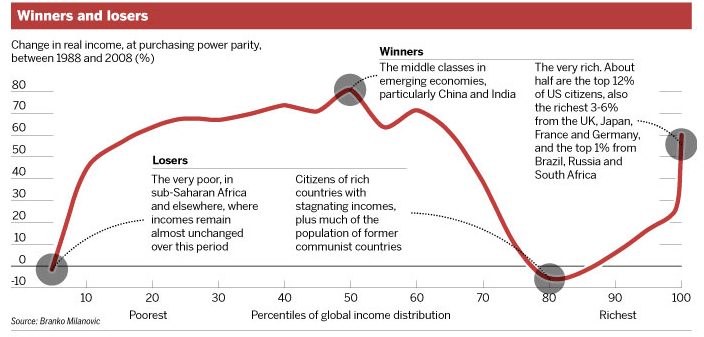
- “Globalism is a force both for good and bad”
- “Inequality is neither economical nor technological, it is ideological”
- Piketty’s reform agenda:
- Power sharing within large firms
- Punitive tax rates → ownership of capital temporary
- Universal capital endowment, UBI
28: The end of capitalism, or the beginning?
- Core challenges: inequality, rising debt levels, authoritarianism, poor financial architecture, climate change
- Polycrisis
- Argument that it’s capitalism itself that’s the only underlying problem
- Capitalism’s biggest crisis of legitimacy since the 1930s
- GPTs (AI most powerful of all)
- AI is a basis for a 4th Industrial Revolution (accelerates innovation)
- Degrowth: won’t work because there will be too many losers
- Instead, an alternative post-capitalist economy
- Evidence of de-globalization: world trade peaked in 2008
- —
- Economic forces + ideologies align → hegemony
- Willed ideologies vs organic ideologies
- Managed capitalism hegemonic block:
- Manual workers, educated liberals, domestically-focused businesses, long-term capital, continued exclusion of many parts of the world, Keynesian / social democratic policy ideas
- Globalized hyper-capitalism hegemonic block:
- Educated workers, int’l-minded businesses, short-term capital, entry of previously excluded parts of the world, free market policy ideas
- What block can exercise power in a world shrunken by social media, yet increasingly splintered?
- Candidates: China (before Xi), Trump
- —
- Economists for inclusive prosperity:
- Wage boards to reign in monopsonies
- Expand early childhood education
- Tax multinational corps where they make their sale
- Reforming patent system to reduce monopoly power
- Beefing up int’l financial regulation, labor standards
- Should shrink capitalism to where it’s useful
- Argue political + economic forces aligning for ↑
- Gig work is shrinking capitalism (techno-capitalism eating itself)
- Large parts of economy must not be driven by profits
- “The system cannot rest” – capitalism will evolve