Bowling Alone
Robert Putnam2000
- Length
- 18h 56m~544 pages
- Read
- Nov 5th - 19th '24
Summary
America's social capital – the networks of trust, reciprocity, and civic engagement that make democracy work – has been in freefall since the 1960s. The collapse is generational, not lifecycle: each successive cohort is less engaged than the last. The culprits are television (solo leisure time), suburban sprawl (destroying walkable civic spaces), two-career families (eliminating volunteer time), and the passing of the uniquely civic WWII generation. The consequences are measurable – lower trust, worse health outcomes, weaker democracy – and the solutions require rebuilding bridging social capital that connects diverse groups, not just bonding capital that reinforces homogeneity.
“Social capital makes us smarter, healthier, safer, richer, and better able to govern a just and stable democracy”
“Honesty and trust lubricate the inevitable frictions of everyday life”
“We have changed our environment more quickly than we can change ourselves”
Key Takeaways
Notes
1: Introduction
- Social capital theory: social networks have value; generalized reciprocity
- Physical, human capital
- Social capital discovered in the 1910s, 1950s-1980s
- Social capital is both a public and private good
- Dimensions of social capital (not mutually exclusive):
- Bonding: (exclusive) reinforce homogeneous groups
- Bridging: (inclusive) encompass diverse social cleavages
- Declared rise of individualism, waning of community for 2+ centuries
- Stats on perception of decline in morals, community since 1980s
2: Trends in civic engagement + social capital
2: Political participation
- 1960: 62.8% → 1996: 48.9%
- Inter- vs intra-cohort social change
- Decline in participation is generational (inter-cohort)
- Fewer people follow public affairs now than 25 years ago (down ~20%)
- Physical capital is replacing social capital
- 50% decrease in citizen political involvement, 5x increase in PAC spending
- Civic participation down across the board
- Just about as well-informed
- 10-15% less likely to express views
- 15-20% less interested in politics
- 25% less likely to vote
- 35% less likely to attend public meetings
- 40% less engaged in party politics
- Possible reason: soured sentiment towards the government and its effectiveness
3: Civic participation
- 3 types of voluntary associations: community-based, church-, and work-
- Not many modern interest groups / communities have local chapters
- Eg. AARP (33 million card holders)
- ↑ little correlation with these groups and social capital
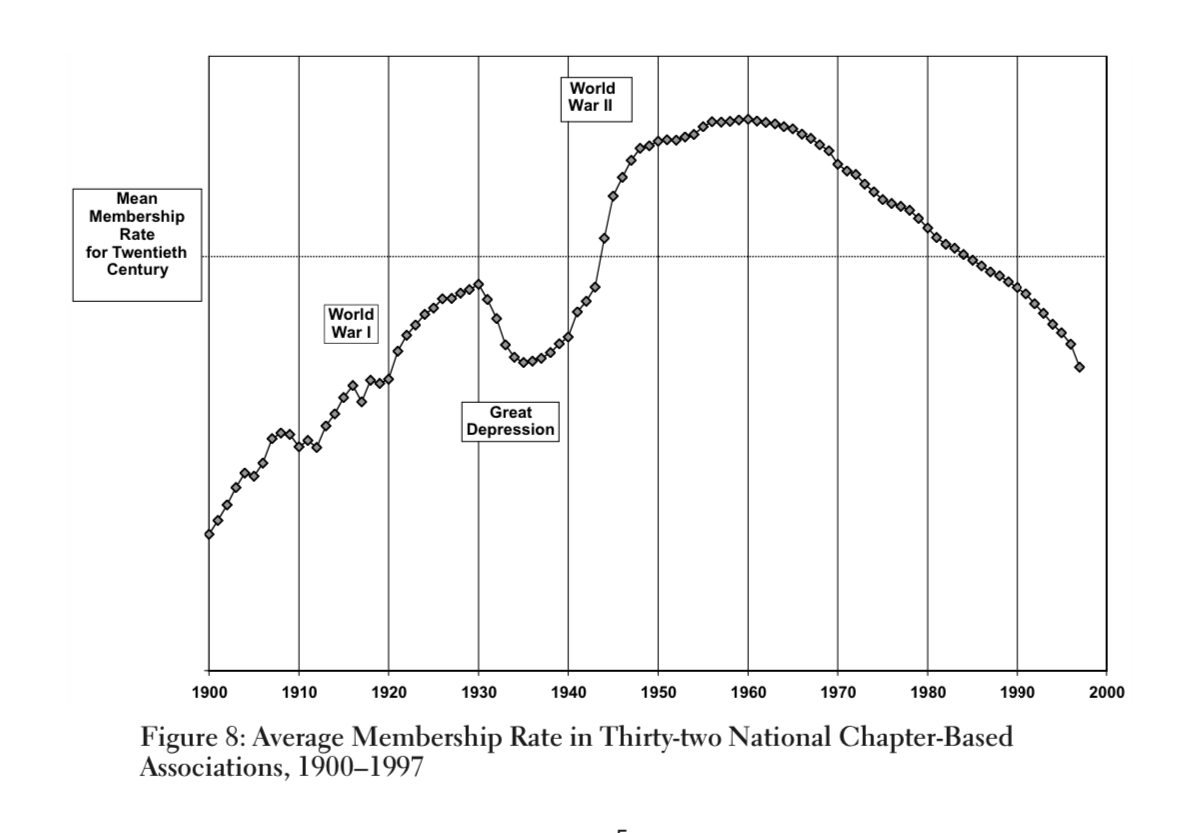
- PTA membership peaked in 1960s at 50%, down to 20% or so in 1990s
- Overall decline in membership #s is modest
- ~50% drop
- Trends in work, religion are more important
4: Religious participation
- Religion is:
- 50% of all organizational memberships
- 50% of all philanthropy
- 50% of all volunteering
- Religious people talk with 40% more people during the day (#1 predictor of sociality)
- Sociological theory of secularization: more modern → more secular
- Peak church membership in 50s and 60s
- 10% less likely to claim church membership
- 25-50% drop in attendance, involvement
- Protestant, Jewish ↓; Catholic, other ↑
5: Connections in the workplace
- Unions as monopolies
- Only 25-50% of labor union decline due to structural shift to industrial → service work
- Possible cause: skepticism of membership
- Significant growth in professional membership (50%), but recent stagnation
- More of social life is work
- Increased job churning
- More workplace competition
- Results are largely inconclusive
- Avg # times hosting friends at home per year: 15 → 8 in 20 years
- Communal eating down ~50%
- League bowling down 40% despite 10% increase in number of bowlers
- Schmoozers vs machers
- More consumption of culture than production of culture
7: Altruism, volunteering, philanthropy
- “Altruism is an important diagnostic sign of social capital”
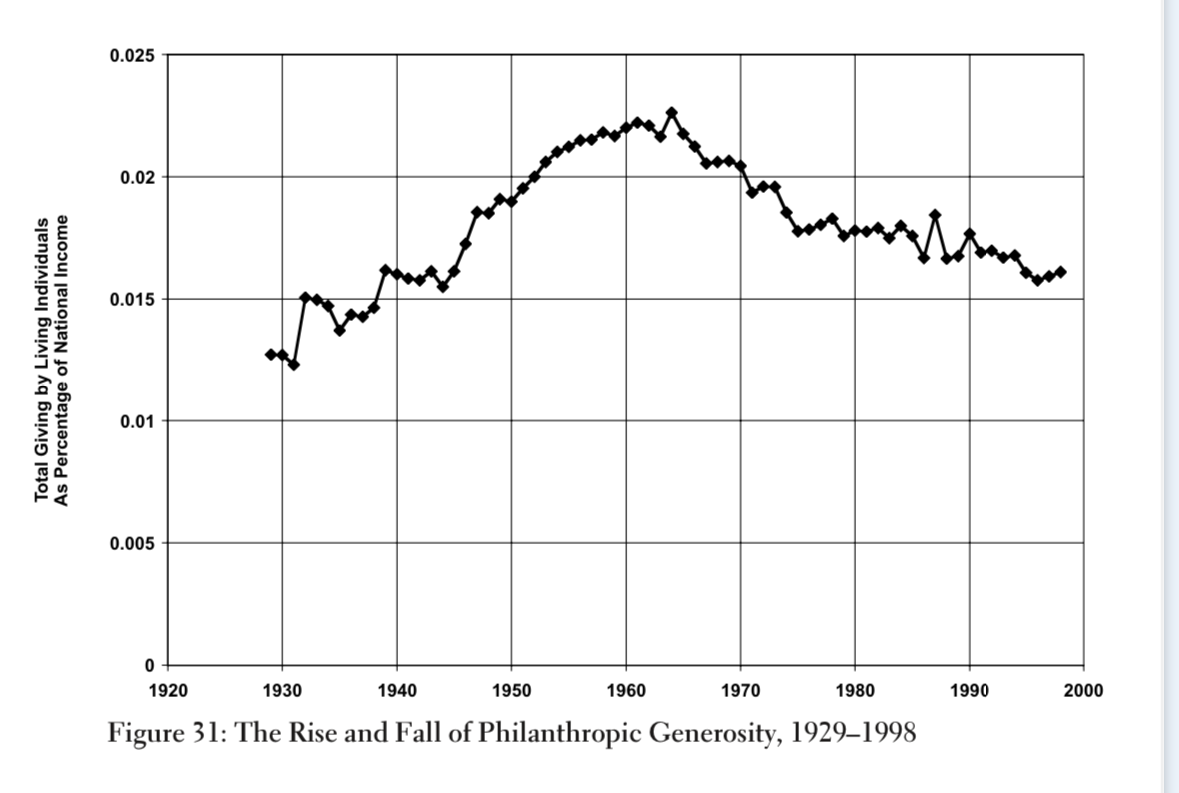
- Church → foundation, corporation, community organizations
- Education is strongest predictor of altruistic behavior
- Volunteering fosters more volunteering
- % of GDP to philanthropy peaked in the 60s
- Less decline for individual (vs community) volunteering
- Most promising among millennials
8: Reciprocity, honesty, and trust
- Generalized reciprocity: “Short-term altruism, long-term self-interest”
- “Honesty and trust lubricate the inevitable frictions of everyday life”
- Thick trust: honesty is encouraged in dense social networks
- Thin trust: social trust, benefit of the doubt, assuming positive intent
- “City air liberates”
- General trust in others: 80% → 50%
- Experience in thin trust
- We’re increasingly forced to rely on institutions and law
9: Against the tide
- How do small groups, social movements, and telecommunications qualify our judgements about declining social connectedness and civic engagement?
- More book clubs / discussion groups
- Social activism of 60s → professional social movement organizations
- Cheap participation: expressing preferences rather than putting in effort
- Social movements + church
- Internet speculation*
3: Why
10: Introduction
- Smaller, more fluid interest groups
- Unsure if cause or result
- Following chapters analyze 5 potential incidences of creation and destruction of social capital
11: Pressures of time and money
- Not clear whether we’re working harder since the 1960s
- Less housework, earlier retirement
- Generally agreed that college educated have lost time, not “” have gained time
- Time pressure probably isn’t it
- Financial pressure contributes no more than 5% of drop in community
- Women working drops community participation, but still <10% of total
12: Mobility and sprawl
- Residential stability strongly correlated
- Residential mobility is actually at an all time low at the close of the century
- Home ownership increasing (62%)
- Move towards urban, suburban living
- More homogeneity → less civic involvement
- More solo commuting, traveling further
- Metropolitan sprawl is a significant contributor for 3 reasons:
- Sprawl takes time (eg. driving)
- Associated with increased social segregation
- Disrupts community boundedness
13: Tech and mass media
- Individualized, privatized consumption/ leisure time
- “Companionship can be simulated electronically”
- News interest is dropping
- Habitual TV watching
- TV minimalists vs maximalists*
- Shortening attention span
- This, TV is likely the leading cause
14: From generation to generation
-
- Education, then 2) age as biggest predictors of civic engagement
- Born in 1920s vs 1960s → 50% reduction across the board
- Boomers as more laid back, individualistic, “free agents”
- Increase in materialism
- Decreased thin trust
- Increased depression, suicide
- Increase in high school volunteering
- 50% is due to generational change
- External conflict increases internal cohesion
- “WWII, coupled to some extent with the Great Depression, was probably the most leveling event in American economic history”
- Eg. wealth held by 1%, top 5% share of all income
- In comparison, Vietnam war led to widespread cynicism
- Communal → individual, material values
- Elements of a good life study:
- 1975: 38% money, 38% purposeful job
- 1996: 63% money, 32% purposeful job
15: Summing up
- Loosening of family bonds
- Less marriage, fewer children
- ↑ though probably doesn’t change overall community involvement much
- Civic white flight: mostly provably false
- Gov’t size has little/no correlation
- Gov’t spending trends 30s-90s:
- Steady as % GNP
- Declining DoD spend
- Increasing local + state spend
- Market capitalism: not likely
- Summary of likely causes:
- 10% time + money pressures
- 10% suburbanization
- 25% TV / privatized leisure
- 50% generational change
- 10-15% “the TV generation”
4: So what?
16: Introduction
- Benefits of social capital:
- Allows citizens to resolve collective problems more easily
- Trust: ↑ trust → better business
- Sympathy: widens awareness of the many ways our fates are linked
- Information flow
- Physical health
- “Social capital makes us smarter, healthier, safer, richer, and better able to govern a just and stable democracy”
- Lower social capital → politicians more important, public activism less impactful
17: Education and children’s welfare
- Social capital > race, poverty, adult education levels correlation with SAT scores
- ↑ time spent informally connecting > formal activities
- Catholic private schools perform better due to high-trust social networks
18: Safe and productive neighborhoods
- Cities should be designed to maximize informal contact among neighbors
- “Social organization”:
- Sense of community
- Positive neighborhood identification
- Explicit norms and sanctions against abhorrent behavior
- Neighborhood cohesion
19: Economic prosperity
- Strength of weak ties*
- Study: each employed person in network increases annual income by $1400
- Silicon Valley + Homebrew Computer Club*
20: Health and happiness
- Possible reasons why social cohesion matters for personal health:
- Tangible assistance / safety net
- Reinforce healthy norms
- Might act as a psychological triggering mechanism
- Most benefit from meetings ~every 3 weeks, little improvement after that
21: Democracy
- Associations are good places to learn leadership and politically valuable skills
- Participation and extremism may be linked
- Argument: paying associations to advocate for us is an efficiency gain
- Social capital is the only predictor of tax compliance
- Sharp increase in more tolerant views with decline in civic engagement
- Are liberty / freedom and community / fraternity at odds?
- Counter: positive link between connectedness and tolerance
- No good studies linking community and intolerance (except Catholics)
- Nope, probably just coincidence of generational change
5: What is to be done?
23: Lessons of history
- The gilded age: 1870s-1890s
- The progressive era: 1890s-1920s
- Industrialization, population growth, urbanization, materialism, consumerism, women’s rights, corruption, immigration issues, race
- More concerns back then echoing now:
- Communication technology
- Cheap entertainment
- Morality eroding, social fracturing
- Individualism, superficiality
- “We have changed our environment more quickly than we can change ourselves”
- Universal desire for a “simpler time”
- “Then as now” timeless worries*
- Optimism, societal reform > individual issue
- 50% of all mass membership orgs (> 1% population) were founded in 1870-1920
- The settlement movement:
- Intense political, social reform
- Downsides:
- Slandering of democracy
- Elitism
- “Big brother-ism”
- We need another era of civic inventiveness
- Increase supply and demand
- Individual and collective action
- Focus on the next generations
- Educational encouragement
- Community service programs
- Need a combo of values and fun
- Reduce cost of sprawl
- …