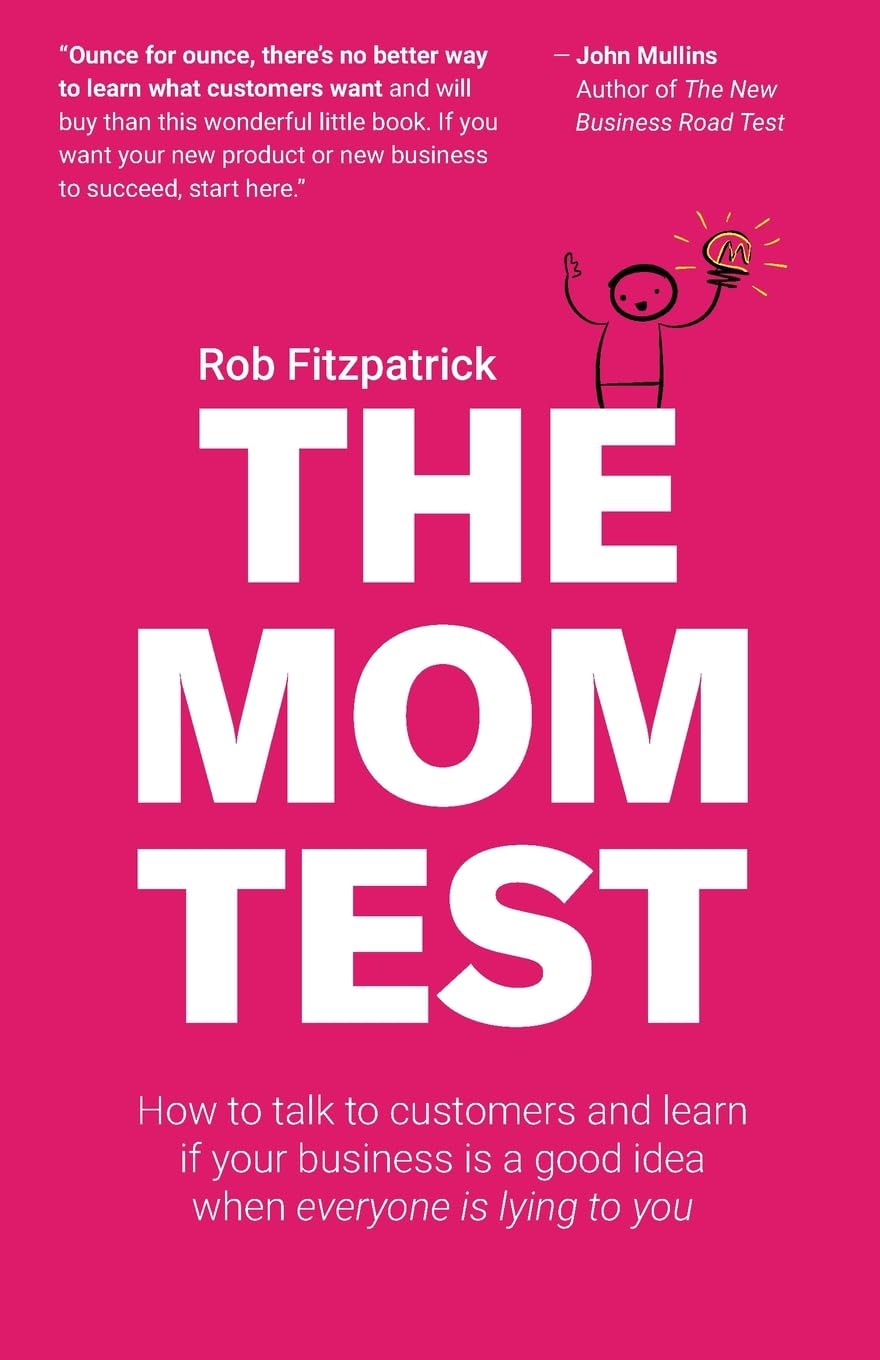
The Mom Test
Rob Fitzpatrick2013
- Length
- 3h 50m~135 pages
- Read
- Nov 6th - 19th '23
- 2nd Read
- Jan 28th - Feb 6th '26
Originally read: 11/06/2023 - 11/19/2023
Summary
The Mom Test is a framework for conducting customer conversations. The core premise: people will lie to you to be polite. Don't ask about your idea directly; instead, ask about their life, their problems, their past behavior, and their existing solutions. Talk about specifics in the past, not hypotheticals in the future. The customer owns the problem; you own the solution.
Extract real commitment – time, reputation, or money. Meetings without advancement are failures. Fitzpatrick also covers finding conversations (warm intros, hosting events, the VFWPA framework for outreach), choosing customers (startups drown from lack of focus – niche down aggressively), and running the process as a team rather than siloing customer insights with one person.
Key Takeaways
Notes
1: The mom test
- Bad interviews are worse than none at all
- Explore behaviors, pain points
- Keep digging deeper
- Usefulness: concrete facts about life, world view
- The mom test:
- Talk about their life, not your idea
- Ask about specifics in the past, not hypotheticals in the future
- Talk less, listen more
- Focus on the why of feature requests, not the what
- Need to be looking for a solution: what have you tried?
- Determine the budget owner or you’ll keep hitting snags
- Who else should I talk to?
- Is there anything I should have asked you?
- Customer owns problem, you own solution
2: Avoiding bad data
- Bad data: Compliments, fluff, ideas
- ALWAYS ignore + deflect compliments
- Fluff: hypotheticals, indirectness
- Don’t put your ego on the line → invites fluff + compliments
- Reject specifics, ask for concrete examples
- When’s the last time?
- Feature request: dig to understand why
- Don’t take solution at face value → seek the PROBLEM
- IDEAL: they’re already paying to fix the problem
3: Asking important questions
- Ask 1+ questions that you’re terrified might kill your business
- Love bad news, mediocre reception (learnings)
- Don’t waste time on irrelevant customers
- Ask “what are your biggest priorities” / time sinks / painful moments without biasing
- Product vs market risk:
- Product: prototype + test
- Customer / market risk: user interviews
- Memorize the top 3 things you want to know (can shift weekly)
4: Keeping it casual
- Be informal, spontaneous
- Facing problem → investigate → industry
- 5 → 15 → 60 mins
5: Commitment and advancement
- Push for advancement (watch out for zombie leads who don’t progress)
- Meeting MUST end with a commitment to advance to the next step, else failed
- Time: next meeting
- Reputation: intros, testimonial
- Money
- What do I need to get to for [next step]?
- You’re trying to get more data / learning / assess desire in early stages → add friction (not remove)
- First hires are kinda crazy - taking a risk on you w/ a strong emotional need
- Understand individual customer first
6: Finding conversations
- Cold calls: find an excuse to talk, not formal and on a calendar
- PHD, writing a book
- Share findings
- Plant a flag your customers can see:
- Host events ⭐️
- Blog
- Warm intros are the best
- Profs, investors, advisors
- Cash in all your small favors
- Framing: not interview or feedback
- How to frame when reaching out: VFWPA
- Vision: entre trying to fix problem
- Framing: no product to sell
- Weakness: specific unknowns
- Pedestal: how they in particular help
- Ask: explicitly ask them to help you
- ↑ reiterate in intro
- Have a plan, guide, and set the agenda
- Strongly prefer in-person over calls
- No one makes friends over the phone
- Helpful mental framing: you’re looking to hire them as an advisor, NOT as a client or customer
- How much time?
- Either until you’ve heard everything before, or
- Fixed part of life (eg. 4h/w)
- Eg. 2h/w with sales people, 1h/w responding to customer tickets, 1h/w attending events
7: Choosing your customers
- Focus: startups don’t starve, they drown
- NICHE DOWN
- Use industry experts to segment industry
- Customer segmentation: slice thinly
- You should enjoy talking to them
- Who + where pair
- Know whole value chain
- All stakeholders, not just the buyer
8: Running the process
- Customer discovery should be shared by all product stakeholders (eg. engineers)
- Store content + emotion (eg. smily face)
- Convey the inputs, not the conclusions to the team
- Touch type
- Don’t just go through the motions*
- Key skills:
- Asking good questions
- Avoiding bad data
- Keeping it casual
- Pushing for commitments / advancements
- Framing the meeting (VFWPA)
- Customer segmentation
- Prepping + reviewing